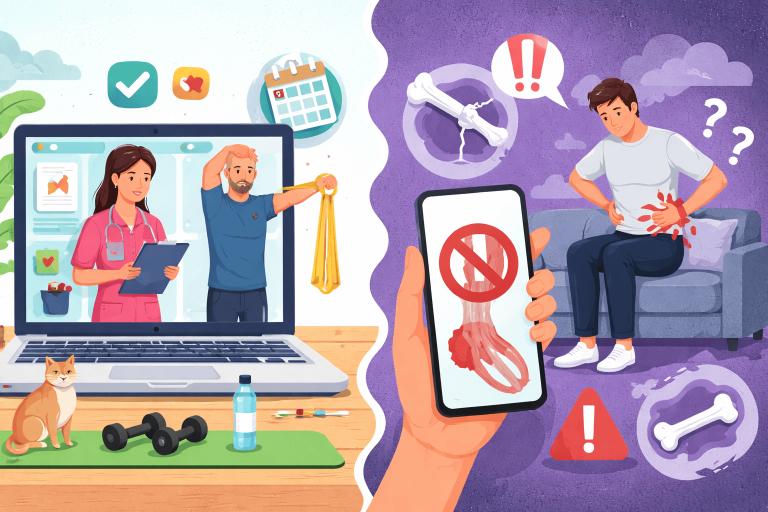
Who Should Choose Online Physiotherapy?
A senior physiotherapist’s honest clinical guidance for patients and caregivers
Over the last few years, many of my patients have asked the same question: “Doctor, does online physiotherapy really work—or is it just a compromise?”
This confusion is understandable. Online physiotherapy (also called virtual or tele-physiotherapy) became popular quickly, often without proper explanation of who it is suitable for, who it is not, and what outcomes are realistic.
This article is written to help you make a safe, informed decision, not to promote online rehab blindly.
What Is Online Physiotherapy—Clinically Speaking?
Online physiotherapy is guided rehabilitation delivered through video consultations, where a qualified physiotherapist:
Assesses movement, posture, and function visually
Designs a personalized exercise and activity plan
Supervises exercises in real time
Modifies treatment based on your response
It is not just watching exercise videos. When done correctly, it follows the same clinical reasoning used in in-person care—within certain limits. For patients and families, a guide to selecting online physiotherapy can help ensure you choose a service that maintains quality, safety, and effectiveness.
Who Is Online Physiotherapy Most Suitable For?
Based on clinical experience, online physiotherapy works best for specific patient profiles, not everyone.
1. Patients With Mild to Moderate Musculoskeletal Pain
This includes:
- Chronic back or neck pain
- Early knee or shoulder pain
- Postural strain from desk work
If pain is movement-related and stable, online guidance can be effective for correction, strengthening, and education.
2. Patients Who Are Medically Stable
Online physiotherapy is appropriate when:
There is no recent trauma
Online physiotherapy is safest when there hasn’t been a recent injury like a fracture, ligament tear, or surgery. This ensures exercises won’t disrupt healing or worsen the condition.
No rapidly worsening symptoms
If pain, weakness, or numbness is suddenly increasing, online sessions may not be enough. In-person evaluation is needed to rule out serious complications before starting therapy.
Medical diagnosis is already established
Patients with a confirmed diagnosis benefit most from online physiotherapy because the therapist can safely tailor exercises and progression. Unknown or undiagnosed conditions require hands-on assessment first.
Example from practice:
A middle-aged IT professional with long-standing neck pain improved posture, mobility, and pain control through supervised online sessions and home corrections.
3. Patients With Mobility or Travel Limitations
Online rehab is helpful for:
Elderly patients who find travel exhausting
For many older adults, repeated clinic visits can increase fatigue, pain, or fall risk. Online physiotherapy allows them to receive guided care safely from home while conserving energy for recovery with expert physiotherapy care in Ahmedabad.
Patients in remote or underserved areas
When access to qualified physiotherapists is limited, online sessions help bridge the gap. Patients can still receive evidence-based guidance, monitoring, and progression without compromising safety.
Those recovering at home after discharge
After hospital discharge, continuity of care is crucial. Online physiotherapy supports safe movement, exercise progression, and early problem identification during this vulnerable recovery phase.
4. Patients Who Can Follow Instructions Safely
Online physiotherapy requires:
- Ability to understand instructions
- Adequate vision and hearing
- A safe home environment
Patients who actively participate usually see better outcomes.
5. Long-Term Condition Management
Conditions like:
Chronic arthritis
Online physiotherapy helps patients manage joint stiffness, maintain mobility, and reduce pain through guided exercises and posture education. It supports long-term function without the need for frequent clinic visits.
Postural imbalance
Therapists can correct poor posture remotely by teaching alignment cues, strengthening weak muscles, and monitoring progress in real time, helping prevent strain and future discomfort.
Early Parkinson’s (with prior in-person assessment)
Patients in the early stages can benefit from online physiotherapy for movement training, balance exercises, and daily activity strategies provided an initial in-person evaluation has ensured safety.
Who Should NOT Rely Only on Online Physiotherapy?
This is where many online articles fall short.
Online physiotherapy is NOT ideal if you have:
- Severe or rapidly worsening pain
- Progressive weakness or numbness
- Recent fractures or surgery (early phase)
- Severe balance loss or frequent falls
These situations need hands-on assessment and physical support.
Red Flags That Require Immediate Medical or In-Person Care
Seek in-person evaluation if you experience:
- Sudden loss of bladder or bowel control
- New neurological symptoms (speech, vision, limb weakness)
- Night pain, fever, or unexplained weight loss
- Pain that does not change with movement
Online physiotherapy should never delay medical diagnosis.
What Online Physiotherapy Can Do Well—and What It Cannot
What Works Well
- Exercise supervision and correction
- Posture and movement education
- Gradual strengthening and mobility training
- Self-management guidance
What Has Clear Limitations
- Manual therapy and hands-on techniques
- Physical balance support for high-risk patients
- Early post-operative tissue handling
Step-by-Step: How to Start Online Physiotherapy Safely
Step 1: Proper Initial Screening
A good online physiotherapist will ask about:
- Medical history
- Imaging or diagnosis
- Red flag symptoms
Step 2: Clear Goal Setting
Goals should be functional, such as:
- Walking longer without pain
- Climbing stairs safely
- Reducing daily stiffness
Step 3: Supervised Exercise Sessions
Exercises must be:
- Demonstrated
- Observed
- Corrected live
Step 4: Progression and Monitoring
Plans should change based on:
Pain response
Monitoring how your body reacts to exercises ensures that therapy remains safe and effective. Adjustments are made if pain increases, preventing injury and promoting gradual recovery.
Fatigue levels
Physiotherapy considers your energy and endurance, avoiding overexertion. Exercises are paced to build strength and stamina without causing setbacks or discouragement.
Functional improvement
Progress is measured by your ability to perform daily tasks safely and independently. Therapy focuses on real-life improvements, not just completing exercises.
Realistic Recovery Expectations With Online Physiotherapy
From clinical experience:
- Mild musculoskeletal issues: 2–6 weeks
- Chronic pain conditions: ongoing management
- Neurological conditions: supportive, not curative
Common Home Mistakes That Reduce Online Rehab Results
I frequently see patients struggle because of:
- Skipping sessions once pain reduces
- Doing extra exercises without guidance
- Ignoring fatigue or warning pain
- Poor camera setup limiting therapist observation
Final Doctor’s Perspective
Online physiotherapy does work—for the right patient, at the right stage, with the right supervision.
It is not a replacement for all in-person care, but it is a valuable, evidence-supported option when used appropriately.
If your physiotherapist:
- Screens you carefully
- Explains limitations honestly
- Adjusts treatment based on response
Then online physiotherapy can be safe, effective, and empowering. Your treatment choice should feel informed and confident—not rushed or marketed.
Who Should Choose Online Physiotherapy - FAQs
References