
Specialized Sports Injury Rehabilitation in Ahmedabad – Regain Strength & Confidence
A 24-year-old cricketer sits in front of me. His MRI says “Grade 2 ligament injury.” His swelling has reduced. His strength looks “almost normal.” His coach says he should be back in 2 weeks. But when I ask him to simulate a pivot, he hesitates. Not because of pain. Because of fear.
In my clinical practice, the biggest mistake I see in sports injury recovery is returning to sport based on time — not capacity.
Most online sports rehab articles fail athletes because they:
- Give exercise lists without progression logic
- Ignore psychological readiness
- Skip return-to-play criteria
- Treat swelling like a minor issue
- Never discuss re-injury risk
- Assume strength equals performance
This guide is different. It is written to help injured athletes in Ahmedabad make smart, safe, performance-based decisions — even if that means delaying your comeback.

REAL ATHLETE PROBLEMS I SEE EVERY WEEK
Let’s address what truly stalls recovery.
Why does my swelling keep coming back?
Because your joint is not load-ready. Swelling is often a sign that tissue tolerance is still low. Many athletes jump from basic strengthening directly into practice intensity. Biology doesn’t negotiate.
My strength is back. Why don’t I feel game-ready?
Because strength testing in a clinic ≠ chaotic sport environment. Running straight is not cutting. Jumping in isolation is not landing under pressure.
Return-to-sport requires:
- Reactive stability
- Neuromuscular timing
Confidence under unpredictability
Social Media Rehab Myths
- “No pain, no gain.”
- “If MRI shows tear, surgery is the only solution.”
- “ACL rehab takes exactly 6 months.”
In reality:
- Tendons need graded loading — not aggressive stretching.
- Not every tear requires surgery.
- Many ACL grafts fail because athletes return too early, not too late.
Common Gym Mistakes
- Progressing weight without improving mechanics
- Ignoring conditioning
- Overtraining upper body and neglecting lower kinetic chain
- Using knee sleeves as psychological crutches
Clinical judgment matters here.
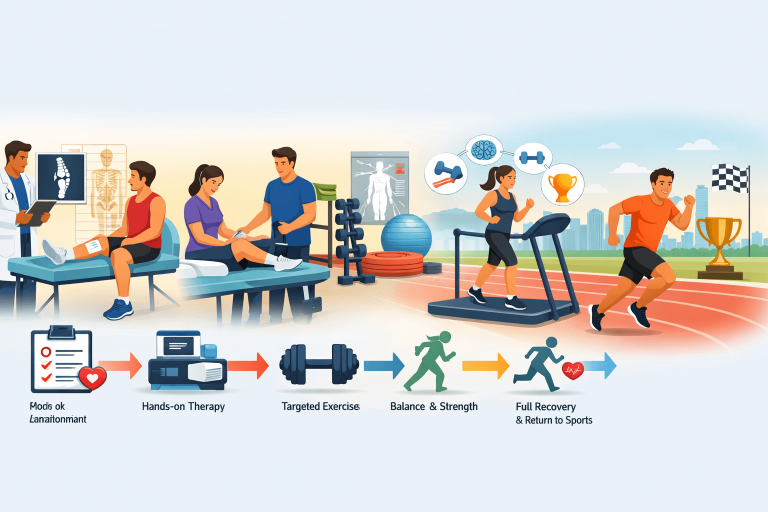
STEP-BY-STEP CLINICAL ACTION PLAN
Step 1: Accurate Injury Classification & Red Flag Screening
What to do:
Full movement assessment, ligament stability testing, swelling grading, functional screening.
Why it matters:
Different injuries tolerate load differently. A tendon behaves differently than a ligament.
Common mistake:
Starting exercises before knowing tissue irritability level.
Red flags requiring referral:
Locking joint
If your joint suddenly gets “stuck” and you physically cannot straighten or bend it, that is not normal stiffness. True locking can indicate a mechanical block inside the joint (like a meniscus tear or loose fragment). This needs proper medical evaluation — forcing movement can worsen the injury.
Progressive instability
If your knee, ankle, or shoulder keeps “giving way” more often over time, that suggests structural support may be compromised. Instability that increases not decreases with rehab is a red flag and may require imaging or specialist referral rather than just more strengthening.
Severe night pain
Pain that wakes you up repeatedly at night, especially without recent heavy activity, deserves attention. Persistent night pain can sometimes indicate inflammatory, infectious, or more serious underlying conditions and should not be ignored or self-managed with exercises alone.
Suspected fracture
If there was significant trauma followed by swelling, sharp pain, inability to bear weight, or visible deformity, a fracture must be ruled out before starting physiotherapy. Continuing to load a possible fracture can delay healing and cause complications, which is why evaluation at an expert physiotherapy clinic for injury recovery is essential.
Step 2: Smart Pain & Swelling Control
- Not just ice and rest.
- We regulate load.
Why it works:
Swelling inhibits muscle activation (especially quadriceps in knee injuries). Persistent swelling delays neuromuscular recovery.
Athlete mistake:
Ignoring mild swelling and pushing through.
Step 3: Mobility & Joint Integrity Restoration
Mobility without control is dangerous.
We restore:
- Controlled range
- Joint positioning awareness
- Symmetry
Common mistake:
Aggressive stretching on unstable joints.
Step 4: Strength & Progressive Load Development
This is where most rehabs fail.
We build:
Tissue tolerance
This refers to how much load your injured muscle, tendon, or ligament can safely handle without flaring up. If swelling or pain increases after training, it usually means the load exceeded your current tolerance — not that the rehab “failed,” but that progression needs adjustment.
Limb symmetry (often aiming ≥ 90% before sport)
Before returning to sport, we typically compare strength and performance between injured and uninjured sides. Many return-to-play protocols suggest at least 90% symmetry, but numbers alone are not enough — movement quality and confidence matter just as much.
Eccentric control
This is your ability to control a muscle while it lengthens — like lowering into a squat or decelerating while landing. Poor eccentric control increases stress on joints and is a common reason for re-injury during cutting, landing, or sudden stops.
Rate of force development
This is how quickly your body can produce force — crucial in sprinting, jumping, and reacting during sport. An athlete may be strong in slow movements but still lack explosive capacity, which is often why “gym strength” doesn’t translate to game readiness.
Step 5: Plyometrics & Sport-Specific Reintegration
Straight-line running is not enough.
For cricket, football, badminton:
- Cutting drills
- Deceleration control
- Multi-directional load
- Fatigue testing
Common mistake:
Skipping this phase because strength “feels good.”
Step 6: Return-to-Sport Testing & Psychological Readiness
Physical clearance is incomplete without psychological readiness.
We assess:
- Confidence scale
- Movement hesitation
- Reactive drills under pressure
Step 7: Long-Term Injury Prevention
This includes:
- Load monitoring
- Conditioning balance
- Periodized training
- Maintenance strength
Rehab ends. Performance maintenance does not.
REAL CASE EXAMPLES
Case 1 – Recreational Runner (Chronic Case)
Age: 36
Sport: Half-marathon runner
Duration: 8 months Achilles pain
Failed attempts: YouTube eccentric exercises only
She had fear of rupture. She avoided speed work entirely.
We implemented:
- Graded isometric loading
- Progressive heavy slow resistance
- Running reintroduction using pain-monitoring model
- Calf capacity testing
Setback: Swelling after week 4 due to over-enthusiasm.
Timeline: 14 weeks to pain-free tempo running.
Outcome: Returned to 10K without flare-up — but not full marathon yet. Realistic pacing.
Case 2 – Post-ACL Competitive Footballer
Age: 21
Surgery: ACL reconstruction
Goal: Competitive return
Initial deficit:
- 30% quad weakness
- Poor landing symmetry
- Fear of pivot
We progressed through:
- Structured strength block
- Controlled plyometrics
- Agility under fatigue
- Limb symmetry testing
Return-to-play clearance at 9 months — not 6. No re-injury at 1-year follow-up.

ATHLETE REFLECTIONS
“I thought I was ready because I could squat heavy. I wasn’t ready to cut.” – 24-year-old footballer
“The confidence training was harder than the physical rehab.” – ACL athlete
“I learned swelling is feedback, not weakness.” – Recreational runner
CLINICAL CREDIBILITY
Research supports:
- ≥90% limb symmetry before return
- Progressive tendon loading principles
- Psychological readiness scales
- WHO physical activity standards
But clinically, numbers guide — they do not decide alone. Capacity + mechanics + confidence = clearance.
WHO THIS GUIDE IS NOT FOR
This guide is NOT for:
- Suspected fracture
- Acute ligament rupture with instability
- Severe swelling with joint locking
- Progressive neurological symptoms
- Infection signs
Athletes expecting instant comeback
This guide does NOT:
- Replace orthopedic consultation
- Provide surgical advice
- Guarantee timelines
- Replace in-person biomechanical assessment
Boundaries build trust.
IF I WERE TREATING THIS TODAY
First priority:
Accurate load tolerance assessment.
One mistake I see repeatedly:
Athletes testing their injury too aggressively.
What I avoid completely:
Clearing athletes based only on time since injury.
One red flag I never ignore:
Recurrent swelling after basic drills.
When I refer:
Persistent instability, mechanical locking, or failure to progress after structured rehab.
Conclusion
Sports injury recovery is:
- Capacity-based
- Progressive
- Psychological
- Measurable
Strength alone does not equal readiness. Confidence must be rebuilt deliberately. If you are unsure about your return stage, consider sports injury rehabilitation in Ahmedabad for a structured assessment and guided recovery before pushing intensity. Avoid comparing timelines online.
Specialized Sports Injury Rehabilitation in Ahmedabad – Regain Strength & Confidence - FAQs
Q1. When can I safely return to sport?
Q2.Is pain during rehab normal?
Q3. Do I need surgery?
Q4. What if strength is back but confidence isn’t?
Q5.Can I train upper body while rehabbing lower body?
References
About the Author

Dr. Hetal M Varia
After a rich experience of working in US healthcare as manager and licensed physiotherapist in US for last 11 years, she has returned home with a vision to become pioneer of Vestibular Therapy and specialized Parkinson physiotherapy in Ahmedabad. With her special skills and expertise in vertigo, Parkinson, balance and movement disorders therapy, Dr. Varia is committed to provide US standards of therapy services , compassionate and patient centered care to our people and community. With a vision of the world where everyone walks strong & steady, she intends to empower individuals with vestibular and neurological disorders through specialized care, rehabilitation & innovative therapies to improve mobility, balance & overall quality of life!