
Vertigo Symptoms Explained: Signs You Shouldn’t Ignore
If you’ve ever felt like the room is spinning around you—even while sitting still—you’re not alone. Many adults between 30 and 65 experience this unsettling sensation at some point in their lives. At Varia Physiotherapy Clinic in Ahmedabad, we frequently meet patients who describe it as “losing balance,” “floating,” or “everything moving suddenly.”
This experience is medically referred to as vertigo, and understanding Spinning Sensation Causes and Cure: What You Must Know can make a significant difference in how quickly and effectively you recover.
Rather than ignoring it or relying on guesswork, it’s important to understand what your body is trying to tell you—and how physiotherapy can help restore your balance safely and effectively.

What Exactly Is a Spinning Sensation?
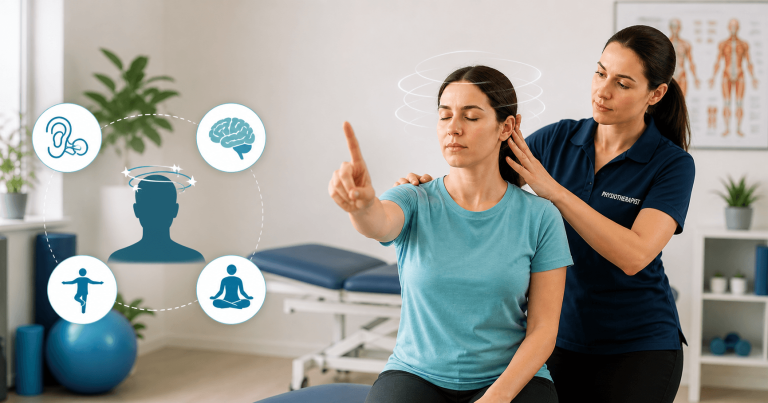
A spinning sensation is not just dizziness. It usually indicates a problem in the body’s balance system, which includes:
- Inner ear (vestibular system)
- Brain (central nervous system)
- Muscles and joints (proprioception)
When these systems don’t work together properly, your brain receives mixed signals, leading to the feeling that you—or your surroundings—are moving.

Spinning Sensation Causes and Cure: What You Must Know About Common Triggers
Understanding the root cause is the first step toward effective treatment. Here are the most common causes we see at our clinic:
1. Benign Paroxysmal Positional Vertigo (BPPV)
BPPV is one of the most common causes of spinning sensation, especially in adults over 40. It occurs when tiny calcium crystals in the inner ear become dislodged and disrupt balance signals. Symptoms are typically triggered by sudden head movements like turning in bed or looking up. The dizziness is brief but can feel intense.
One of the most frequent causes, especially in adults over 40.
- Triggered by sudden head movements
- Caused by displaced calcium crystals in the inner ear
- Symptoms last a few seconds to minutes
2. Cervical (Neck-Related) Vertigo
Cervical vertigo is linked to problems in the neck, such as stiffness, poor posture, or cervical spondylosis. It is commonly seen in people who sit for long hours or use computers extensively. The imbalance occurs due to disrupted signals between the neck and brain, leading to dizziness. Patients often experience neck pain or tightness along with the spinning sensation, and may benefit from effective pain relief physiotherapy in Ahmedabad for long-term improvement.
Often overlooked but very common.
Associated with neck stiffness, poor posture, or cervical spondylosis
Common in people working long hours at desks
3. Vestibular Neuritis or Labyrinthitis
These conditions involve inflammation of the inner ear, usually due to a viral infection. They can cause sudden and severe dizziness that may last for several days. Patients may also experience nausea, imbalance, and difficulty focusing. Unlike BPPV, symptoms are more prolonged and intense.
- Inner ear inflammation due to infection
- Can cause severe dizziness lasting days
4. Migraine-Associated Vertigo
This type of vertigo is associated with migraine and can occur with or without a headache. It is caused by changes in brain activity affecting balance pathways. Episodes may last from minutes to hours and can be triggered by stress, certain foods, or lack of sleep. Sensitivity to light and sound is also common.
- Linked with migraine headaches
- May occur even without a headache
5. Neurological Causes
In rare cases, vertigo may be linked to neurological conditions such as stroke or multiple sclerosis. These conditions affect the brain’s ability to process balance and spatial orientation. Symptoms are often accompanied by warning signs like weakness, vision problems, or difficulty speaking. Immediate medical evaluation is essential in such cases.
In rare cases, vertigo may be related to:
- Stroke
- Multiple sclerosis
- Brain disorders
This is why proper assessment is crucial.
According to the World Health Organization (WHO), balance disorders significantly impact quality of life, especially in middle-aged and older adults.
How Physiotherapy Helps in Treating Spinning Sensation
At Varia Physiotherapy Clinic, treatment is never one-size-fits-all. We follow a structured, evidence-based approach.
Step 1: Detailed Clinical Assessment
A thorough clinical assessment is the foundation of effective treatment. It includes understanding your symptoms, triggers, and medical history, along with evaluating balance, walking patterns, and neck function. Specialized vestibular tests help pinpoint the exact source of dizziness. This ensures the treatment targets the root cause, not just the symptoms.
We begin with:
- Patient history (onset, duration, triggers)
- Balance and gait evaluation
- Cervical spine assessment
- Vestibular function tests
This helps us identify whether the issue is from the inner ear, neck, or nervous system.
Step 2: Targeted Physiotherapy Treatment
Based on the diagnosis, a personalized physiotherapy plan is designed to restore balance and reduce dizziness. Techniques like Vestibular Rehabilitation Therapy (VRT), repositioning maneuvers, and cervical spine treatment are used. These approaches help retrain the brain, correct inner ear issues, and improve neck function. The goal is safe, effective, and long-term relief.
Vestibular Rehabilitation Therapy (VRT)
A specialized program designed to retrain your brain and balance system.
Includes:
- Eye-head coordination exercises
- Balance training
- Habituation exercises
Canalith Repositioning Maneuvers
For BPPV patients, techniques like the Epley maneuver are used to reposition inner ear crystals.
Patients often feel relief within 1–3 sessions.
Cervical Spine Physiotherapy
If the cause is neck-related:
- Manual therapy
- Postural correction
- Strengthening exercises
Neuromuscular Re-education
Improves coordination between brain and body.
Step 3: Home Exercise Program
Recovery continues beyond the clinic with a structured home exercise plan. Patients are guided with simple exercises to improve balance, posture, and movement control. Daily practice helps speed up recovery and prevents recurrence. Consistency is key to achieving lasting results.
Recovery doesn’t stop at the clinic.
Patients are guided with:
- Simple daily exercises
- Posture correction techniques
- Activity modifications
Step 4: Monitoring and Progression
Regular monitoring helps track improvements in balance, dizziness frequency, and overall confidence in movement. Treatment plans are adjusted based on progress to ensure optimal recovery. Timelines vary depending on the condition, but steady improvement is expected. This step ensures safe progression and long-term stability.
We track improvements in:
- Balance
- Frequency of dizziness
- Confidence in movement
Recovery timelines vary:
- BPPV: 1–2 weeks
- Cervical vertigo: 3–6 weeks
- Vestibular conditions: 4–8 weeks
Real Patient Experience from Our Clinic
A 48-year-old office professional came to us with complaints of sudden spinning while turning in bed. She had already visited multiple doctors and was anxious about her condition.
After assessment, we diagnosed BPPV.
- Performed canalith repositioning maneuver
- Educated her about head movements
- Prescribed simple home exercises
Result:
Her symptoms reduced significantly within 2 sessions and completely resolved within a week.
Another case involved a 55-year-old businessman with chronic neck stiffness and dizziness while working long hours.
- Diagnosed with cervical vertigo
- Treated with manual therapy and posture correction
Result:
Improvement in 3 weeks with reduced dizziness and better neck mobility.
Myths vs Facts About Spinning Sensation
Myth: It’s just weakness or low BP
Many people assume dizziness is simply due to weakness or low blood pressure, but this is not always true. In most cases, spinning sensation is linked to the vestibular (inner ear) system or neck dysfunction. Misunderstanding the cause can delay proper treatment. A correct diagnosis is essential for effective recovery.
Myth: Bed rest is the best treatment
While rest may provide temporary comfort, prolonged bed rest can actually slow down recovery. The balance system needs controlled movement to adapt and improve. Physiotherapy exercises are designed to safely stimulate this process. Staying active under guidance is key to faster recovery.
Myth: Medicines alone can cure vertigo
Medications may help reduce symptoms like nausea or dizziness temporarily, but they do not fix the underlying issue. Conditions like BPPV or cervical vertigo require specific physical treatments. Physiotherapy targets the root cause through exercises and manual techniques. This leads to more lasting and effective results.
Myth: It will go away on its own
Some mild cases may improve, but many do not resolve completely without treatment. Ignoring symptoms can lead to frequent episodes or worsening balance problems. Early intervention helps prevent complications and speeds up recovery. Proper care ensures long-term relief and confidence in movement.
When Should You See a Physiotherapist?
Seek professional help if you experience:
- Repeated spinning episodes
- Dizziness while changing positions
- Balance issues while walking
- Neck pain along with dizziness
- Fear of falling
Immediate medical referral is required if:
- Sudden severe headache
- Double vision
- Difficulty speaking
- Weakness in limbs
In such cases, we refer patients to a neurologist or orthopedic specialist for further evaluation.
Conclusion:
Understanding Spinning Sensation Causes and Cure: What You Must Know can empower you to take the right steps toward recovery instead of living in uncertainty.
At Varia Physiotherapy Clinic, we believe in treating the root cause—not just the symptoms. With proper assessment, targeted therapy, and guided exercises, most patients experience significant improvement and regain confidence in their daily movements.
Ethical Call-to-Action
If you’re unsure whether your symptoms need attention, it’s okay to start with a simple consultation. Understanding your condition is the first step toward recovery—no pressure, just guidance.
If you’d like to speak with a physiotherapist or book an assessment at Varia Physiotherapy Clinic, you can reach out here:
 Call: +91 95123 79555
 Email: hello.drhetalvaria@gmail.com
 Website: www.variaphysiotherapyclinic.com
Our team is here to listen, assess, and guide you toward safe and effective recovery.
Spinning Sensation Causes and Cure :FAQs
BPPV is the most common cause, especially triggered by sudden head movements.
Many cases can be effectively treated, especially BPPV and cervical vertigo, with proper physiotherapy.
It depends on the cause—ranging from a few days to several weeks.
Usually not, but it should be properly diagnosed to rule out neurological issues.
Yes, cervical spine dysfunction is a common and treatable cause.
About the Author

Dr. Hetal M Varia
After a rich experience of working in US healthcare as manager and licensed physiotherapist in US for last 11 years, she has returned home with a vision to become pioneer of Vestibular Therapy and specialized Parkinson physiotherapy in Ahmedabad. With her special skills and expertise in vertigo, Parkinson, balance and movement disorders therapy, Dr. Varia is committed to provide US standards of therapy services , compassionate and patient centered care to our people and community. With a vision of the world where everyone walks strong & steady, she intends to empower individuals with vestibular and neurological disorders through specialized care, rehabilitation & innovative therapies to improve mobility, balance & overall quality of life!