
Physiotherapy Clinic In Thaltej Ahmedabad For Fast & Safe Recovery
In my clinical practice across Thaltej, Satellite, Bodakdev, Gurukul, Sola, and SG Highway the biggest mistake I see is patients starting treatment without proper assessment.
Most clinic websites:
- List machines.
- Promise fast results.
- Show exercise photos.
- Avoid discussing red flags.
- Don’t explain when therapy should be delayed or stopped.
This guide will give you clarity — not marketing.

Real Patient Problems I See In Thaltej
Thaltej has a specific lifestyle pattern:
- IT professionals sitting 8–10 hours.
- Business owners drive long hours.
- Gym-goers pushing volume without recovery.
- People self-treating with YouTube exercises.
- Delaying care because of work pressure.
Why pain doesn’t improve despite therapy
1. Passive-only treatment
Heat, ultrasound, TENS — given for weeks.
These reduce symptoms temporarily but don’t build tissue capacity.
2. MRI fear culture
A disc bulge on MRI is common after 30.
Pain ≠ damage.
But patients panic and avoid movement — worsening stiffness.
3. No progression plan
Many clinics don’t track load.
No strengthening timeline.
No measurable improvement markers.
4. Unrealistic 7-day recovery expectation
Chronic pain of 6–8 months doesn’t disappear in 5 sessions.
5. Aggressive treatment in inflammatory stage
Forcing stretches or heavy strengthening too early increases guarding.
What clarity does this give you?
If therapy isn’t structured and progressive — improvement stalls.

How a Responsible Physiotherapy Clinic Should Approach Your Case
Step 1: Proper Assessment & Red Flag Screening
Before any treatment starts, a responsible clinician must check:
Neurological Weakness:
True muscle power loss (like foot drop or weak grip) that suggests nerve involvement and needs medical evaluation before therapy.
Altered Reflexes:
Absent or exaggerated reflexes may indicate nerve or spinal cord issues that require further medical assessment.
Sensory Changes:
Persistent or spreading numbness, tingling, or loss of sensation can signal nerve compression needing evaluation.
Suspected Fracture:
Severe pain after trauma with difficulty moving or bearing weight may indicate a fracture and requires imaging first.
Infection Signs (Fever + Severe Pain):
Constant severe pain with fever or chills may suggest infection and needs urgent medical care.
Progressive Limb Weakness:
Gradually worsening strength in an arm or leg is a serious neurological warning sign.
Bladder/Bowel Symptoms:
New loss of bladder or bowel control or groin numbness is a medical emergency requiring immediate hospital referral.
Step 2: Pain Control Without Passive Dependency
Heat is not a treatment. Ultrasound is not magic.
Pain reduces when:
- Blood flow improves
- Muscle guarding reduces
- Nervous system threat perception lowers
But unless movement is introduced gradually, pain returns.
Biologically:
Tissues adapt to load. They don’t adapt to machines.
Step 3: Restore Mobility Safely
Restricted joints + guarded muscles need graded mobility.
Aggressive stretching in early stage:
Increases Inflammation:
Overloading an irritated tissue too early can worsen swelling and pain instead of helping recovery.
Triggers Protective Spasm:
When pushed aggressively, muscles tighten defensively to protect the area, increasing stiffness and discomfort.
Delays Progress:
Doing the wrong intensity at the wrong stage can set recovery back by days or even weeks. Controlled movement restores range.
Step 4: Build Strength & Load Tolerance
This is where real recovery begins. Pain-free doesn’t mean ready.
Tissue capacity improves only with:
- Progressive resistance
- Load tracking
- Volume management
Without load progression, pain returns during:
- Long sitting
- Stair climbing
- Gym
- Travel
Step 5: Functional Reintegration
Rehab must match life demands:
Desk Tolerance Training:
Gradual conditioning to help you sit and work longer without triggering back, neck, or shoulder pain.
Stair Capacity:
Structured strengthening to improve your ability to climb stairs without knee, hip, or breath-related discomfort.
Lifting Mechanics:
Teaching safe, load-distributed movement patterns so daily lifting doesn’t strain your spine or joints.
Sport Return Drills:
Step-by-step reintroduction of sport-specific movements to rebuild strength, control, and injury confidence safely.
Step 6: Long-Term Prevention Plan
Pain recurrence in Thaltej patients is high because:
- Ergonomics ignored
- Strength stops after pain reduces
- No self-monitoring
WHO physical activity recommendations encourage consistent movement — not cycles of inactivity and sudden overload. Prevention is a structured habit, not occasional exercise.
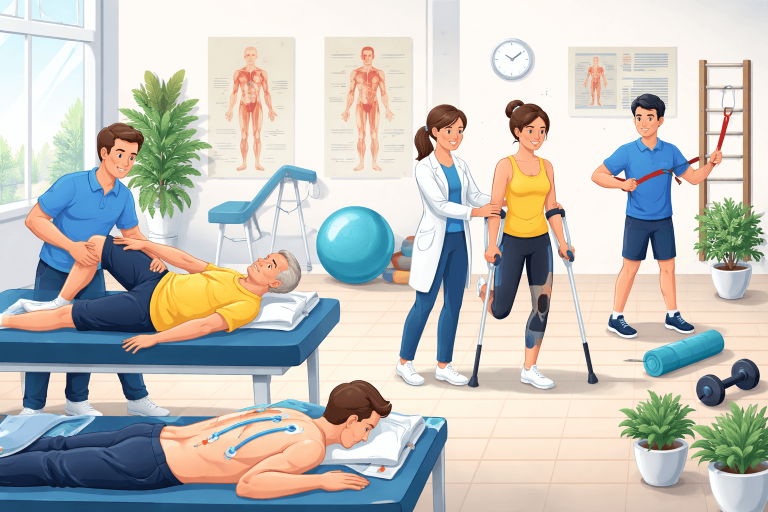
Real Case Examples
Case 1: 42-Year-Old IT Professional – Chronic Back Pain
- 8 months pain
- MRI showed disc bulge
- Fear of surgery
- 15 sessions of passive therapy elsewhere
- No strengthening done
Assessment showed:
- Weak posterior chain
- Poor load tolerance
- Fear-avoidance behavior
We started:
- Pain education
- Gradual hip hinge drills
- Low-load endurance work
Weeks 4–6:
Mild flare-ups during progression.
Weeks 8–12:
- Improved sitting tolerance from 20 minutes → 2 hours.
- Pain not zero — but manageable.
- No surgery required.
Honest outcome:
Chronic but controlled.
Case 2: 24-Year-Old Gym-Goer – Shoulder Pain
- Overhead lifting pain
- Stopped gym completely
- MRI suggested mild tendinopathy
Assessment:
- Weak eccentric rotator cuff
- Poor scapular control
Plan:
- 8-week structured eccentric loading
- Controlled overhead reintroduction
- Volume tracking
Outcome:
- I returned to the gym gradually.
- Avoids high-volume ego lifting.
- Occasional soreness — manageable.
- No dramatic transformation.
- Just capacity improvement.

What Patients Say
“I thought I needed surgery after my MRI.” – 39-year-old business owner
“I didn’t know strengthening mattered more than machines.” – IT employee
Clinical Credibility
Modern rehabilitation follows:
- Load management science
- Pain neuroscience education
- Progressive overload principles
- Functional restoration
- WHO movement guidelines
Rehab is not about eliminating pain instantly; it’s about restoring function safely through trusted physiotherapy care in Ahmedabad.
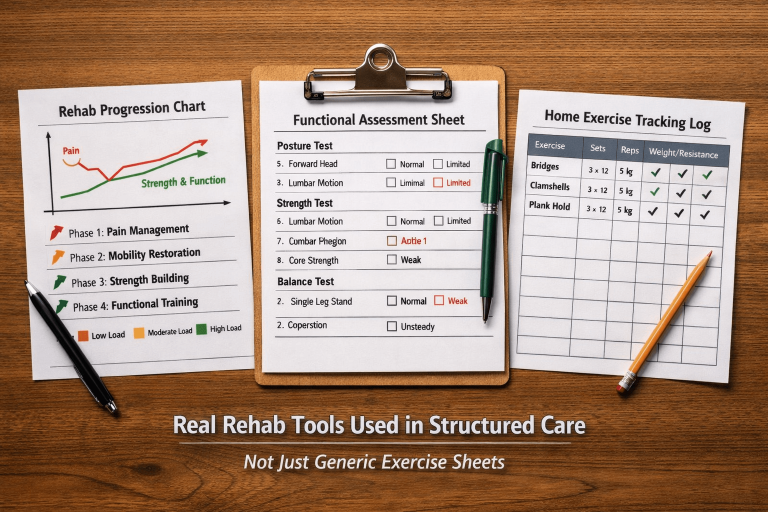
Real Clinical Tools Used
Who This Guide Is Not For
Do Not start physiotherapy if you have:
- Suspected fracture
- Severe neurological symptoms
- Progressive limb weakness
- Infection signs
- Sudden bladder/bowel changes
- Recent major trauma
This guide does Not:
- Replace diagnosis
- Provide medication advice
- Guarantee recovery
- Replace in-person assessment
Boundaries protect patients.
If I Were Treating A Patient In Thaltej Today
First thing I assess:
Movement quality under load.
One mistake I repeatedly see:
Patients chasing pain relief instead of capacity building.
One red flag I never ignore:
Progressive neurological weakness.
What I avoid completely:
Endless electrotherapy without strengthening.
When I refer:
Worsening Neurological Signs
Increasing weakness, spreading numbness, or coordination loss suggests nerve involvement requiring urgent medical review. If symptoms are progressing rather than stabilizing, delaying evaluation can increase the risk of long-term nerve damage. These signs should never be managed with routine exercises alone. Early intervention at a physiotherapy clinic in Thaltej Ahmedabad ensures proper assessment, safe management, and better recovery outcomes.
Suspected Fracture
Severe pain after trauma with inability to move or bear weight needs imaging before any therapy begins. Attempting to “push through” or start exercises without ruling out a fracture can worsen displacement and delay proper healing. Protection and medical clearance come first.
Severe Inflammatory Markers
Uncontrolled swelling, persistent night pain, fever, or systemic symptoms may indicate underlying medical conditions beyond mechanical injury. When inflammation is disproportionate to activity, further medical investigation is necessary before starting rehabilitation. Physiotherapy should support recovery — not mask serious pathology.
Non-Mechanical Symptoms
Pain unrelated to movement or posture — especially constant, unexplained pain — requires medical evaluation before physiotherapy. If pain does not change with rest or activity, it may not be purely musculoskeletal. Identifying this early prevents inappropriate treatment and missed diagnoses.
Conclusion
Choosing a clinic is not about equipment. It’s about clinical reasoning.
Before starting therapy, ask:
- Was I properly assessed?
- Are red flags ruled out?
- Is there a load progression plan?
- Are goals measurable?
Educational CTA:
- Download a self-assessment checklist.
- Comment your symptoms for guidance.
- Request an ergonomic correction guide.
Make informed decisions — not rushed ones.
Physiotherapy Clinic In Thaltej Ahmedabad - FAQs
Q1. Do I need an MRI before visiting a physiotherapy clinic?
Q2. Is pain during exercises normal?
Q3. How many sessions will I need?
Q4.Why did previous physiotherapy not work?
Q5. How do I verify a physiotherapist’s credentials?
References
About the Author

Dr. Hetal M Varia
After a rich experience of working in US healthcare as manager and licensed physiotherapist in US for last 11 years, she has returned home with a vision to become pioneer of Vestibular Therapy and specialized Parkinson physiotherapy in Ahmedabad. With her special skills and expertise in vertigo, Parkinson, balance and movement disorders therapy, Dr. Varia is committed to provide US standards of therapy services , compassionate and patient centered care to our people and community. With a vision of the world where everyone walks strong & steady, she intends to empower individuals with vestibular and neurological disorders through specialized care, rehabilitation & innovative therapies to improve mobility, balance & overall quality of life!