
Effective Exercises To Improve Rounded Shoulder Posture
Rounded shoulders are one of the most common posture problems I see in the clinic across office workers, students, athletes, and even people recovering from surgery or neurological conditions.
Many patients assume: My shoulders are rounded because I sit badly. Posture is part of the story but not the whole problem.
Rounded shoulders usually develop because of muscle imbalance, poor movement control, and reduced endurance, not just habit. That’s why simply “sitting straight” or doing random stretches rarely fixes it long-term.
This guide explains:
- Why rounded shoulders really happen
- How to know if exercises are right for you
- Which exercises actually help (and why)
- Common mistakes that slow recovery
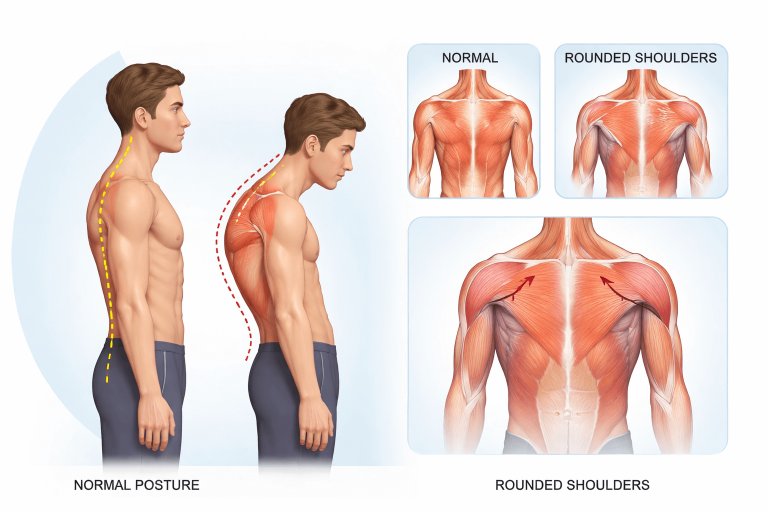
What Are Rounded Shoulders?
Rounded shoulder posture happens when the shoulders drift forward and inward, often with:
- A slouched upper back
- Forward head posture
- Reduced chest expansion
Over time, this changes how muscles, joints, and even breathing patterns work.
Clinical insight:
Rounded shoulders are less about “bad posture” and more about how long your body can hold good posture without fatigue.
Common Symptoms Patients Notice
Patients often report:
- Shoulder or neck tightness
- Upper back discomfort
- Headaches
- Arm fatigue during desk work
- Difficulty maintaining upright posture
In some cases, it can contribute to:
- Shoulder impingement
- Neck pain
- Balance or coordination issues (especially in neuro patients)
Why Rounded Shoulders Develop?
1. Weak Postural Muscles
When the muscles that support your upper back and shoulders lack endurance, it becomes hard to stay upright for long. This isn’t a willpower issue the muscles simply fatigue and the shoulders drift forward.
2. Tight Anterior Muscles
Muscles in the chest and front of the shoulders can gradually shorten with prolonged sitting or repetitive tasks. This tightness gently pulls the shoulders forward, especially when opposing muscles are weak—making it beneficial to consider physiotherapy services in Ahmedabad to restore muscle balance and improve posture.
3. Poor Motor Control
Sometimes muscles are strong but don’t activate at the right time. Poor coordination between the brain and muscles makes it difficult to maintain proper shoulder alignment during daily movements.
4. Breathing Patterns
Sometimes muscles are strong but don’t activate at the right time. Poor coordination between the brain and muscles makes it difficult to maintain proper shoulder alignment during daily movements.
Before You Start Exercises: What to Check First
Not everyone should jump straight into exercises. Physiotherapy assessment looks for:
- Shoulder joint mobility
- Neck involvement
- Nerve symptoms (numbness, tingling, weakness)
- Pain patterns
If you have sharp pain, recent trauma, or neurological symptoms, exercises should be guided — not self-prescribed.
Clinically Proven Exercises to Improve Rounded Shoulder Posture
These exercises are chosen based on clinical reasoning, not trends.
1. Scapular Retraction with Control
This exercise retrains the muscles that pull the shoulders gently back and down.
Why it works:
It improves shoulder blade positioning without forcing posture or overusing the neck.
2. Thoracic Spine Extension Mobility
Gentle upper back extension over a chair or foam roll helps restore lost mobility.
Why it works:
You cannot fix shoulder posture if the upper spine is stiff.
3. Wall-Assisted Postural Holds
Standing against a wall helps the body learn correct alignment with feedback.
Why it works:
It builds postural awareness and endurance, not just strength.
4. Chest Stretch with Breathing Control
Stretching the chest while focusing on slow breathing reduces muscle guarding.
Why it works:
It addresses tightness and breathing mechanics together.
5. Shoulder External Rotation Strengthening
This targets deeper shoulder stabilizers often weak in rounded posture.
Why it works:
These muscles help keep the shoulders from collapsing forward during daily activities.
A Real Clinical Example
Assessment showed:
- Weak upper back endurance
- Poor scapular control
- No structural shoulder problem
After 6 weeks of targeted strengthening and posture retraining:
- Neck pain reduced significantly
- Posture improved naturally without braces
- No conscious “forcing” of posture
What Works — and What Doesn’t
What Works
- Strengthening postural muscles gradually
- Improving upper back mobility
- Consistent, low-load exercises
- Awareness during daily activities
What Doesn’t
- Wearing posture braces all day
- Aggressive stretching without strengthening
- Forcing shoulders back unnaturally
- One-size-fits-all routines
Temporary correction without muscular support always fails.
Step-by-Step: How to Fix Rounded Shoulders Safely
Step 1: Get Assessed
Especially if pain, weakness, or nerve symptoms are present.
Step 2: Start with Control, Not Intensity
Quality of movement matters more than repetitions.
Step 3: Build Endurance
Posture improves when muscles can hold alignment over time.
Step 4: Integrate into Daily Life
Exercises must translate into sitting, working, and walking.
When Physiotherapy May NOT Be Enough
Further evaluation is needed if there is:
- Progressive weakness
- Nerve symptoms in arms
- Severe or worsening pain
- History of trauma or surgery
Physiotherapy should work with medical care when needed.
Common Home Mistakes That Worsen Rounded Shoulders
- Overstretching already weak muscles
- Ignoring upper back stiffness
- Sitting upright briefly, then collapsing
- Expecting instant posture change
Posture correction is a process, not a quick fix.
How Long Does Improvement Take?
- Mild postural issues: 3–6 weeks
- Long-standing desk-related posture: 8–12 weeks
- Neuro or post-surgical cases: gradual, condition-dependent
Progress is gradual — and that’s normal.
Final Thoughts from a Physiotherapy Doctor
Rounded shoulders are not a failure of discipline they are a physical adaptation. With the right exercises, realistic expectations, and proper guidance, posture improves naturally without forcing or discomfort.
The goal isn’t to “stand straight” all the time, but to build a body that can support good posture when it matters.
Physiotherapy Clinic in ahmedabad - FAQs
Q1. How many sessions are usually required?
Q2. Is physiotherapy effective for Parkinson’s?
Q3. What is the average physiotherapy cost in Ahmedabad?
Q4. Can vertigo be cured permanently?
Q5. How do I verify a physiotherapist’s credentials?
References
About the Author

Dr. Hetal M Varia
After a rich experience of working in US healthcare as manager and licensed physiotherapist in US for last 11 years, she has returned home with a vision to become pioneer of Vestibular Therapy and specialized Parkinson physiotherapy in Ahmedabad. With her special skills and expertise in vertigo, Parkinson, balance and movement disorders therapy, Dr. Varia is committed to provide US standards of therapy services , compassionate and patient centered care to our people and community. With a vision of the world where everyone walks strong & steady, she intends to empower individuals with vestibular and neurological disorders through specialized care, rehabilitation & innovative therapies to improve mobility, balance & overall quality of life!