
Best Physiotherapist Near SG Highway Ahmedabad
If you work in an IT office on SG Highway, this may sound familiar:
- Neck pain for 8 months.
- MRI shows “disc bulge.”
- I tried heat therapy at one clinic.
- Dry needling at another.
- Someone suggested surgery.
- You’re still in pain.
Or maybe you’re a gym-goer in Bodakdev doing Instagram rehab drills that flare your shoulder every week.
Or a post-ACL surgery patient in Satellite comparing “packages” instead of understanding rehab progression.
In my clinical practice around SG Highway and surrounding areas, the biggest mistake I see patients make is choosing convenience or fancy equipment over clinical reasoning.
Most “Best Physiotherapist Near Me” articles fail because they:
- Promote facilities, not outcomes
- Don’t explain how treatment decisions are made
- Ignore red flags
- Never tell you when to leave a clinic
This guide is not about ranking clinics. It’s about helping you avoid months of ineffective treatment.

WHAT ACTUALLY DEFINES A GOOD PHYSIOTHERAPIST?
Forget:
- “Advanced machines”
- “Modern setup”
- “20+ modalities”
- “Certified expert” without context
Here’s what actually matters clinically:
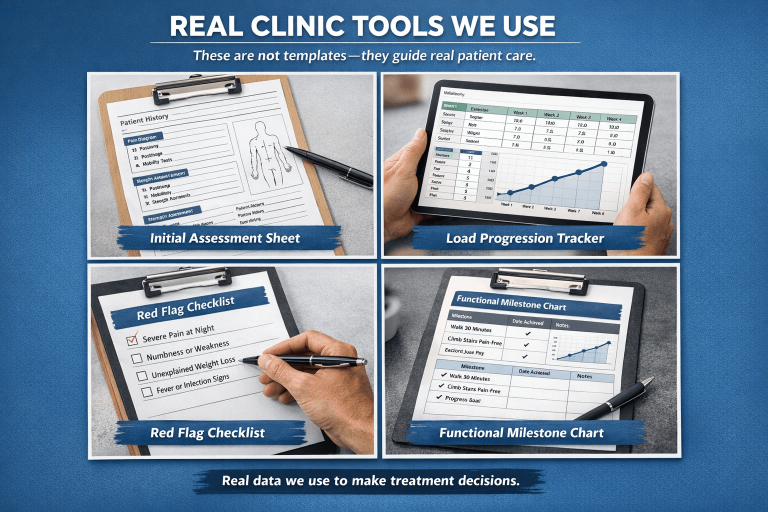
1. Depth of Assessment
A proper first session should include:
Detailed history
A proper assessment begins with understanding your daily life — how long you sit, how you sleep, your stress levels, and how active you are. Pain is often influenced by workload, recovery habits, and emotional stress, not just a single structure. When this step is skipped, treatment becomes temporary symptom control instead of solving the root problem.
Consulting atrusted physiotherapist at a nearby physiotherapy clinic around SG Highway ensures a thorough evaluation and personalized care plan.
Movement analysis
This involves observing how you bend, lift, walk, sit, or reach because poor movement patterns often overload specific tissues repeatedly. Many patients are told they are “weak,” when in reality they are moving inefficiently or compensating due to fear or past pain. Identifying these patterns helps prevent recurrence instead of just reducing pain short-term.
Strength testing
Strength testing objectively checks whether key muscles are underperforming, inhibited, or simply painful. Without measuring strength, exercise prescription becomes guesswork, which is a common reason for recovery plateaus. Real rehabilitation requires knowing exactly what needs to be strengthened and by how much.
Functional testing
This step evaluates what truly matters your ability to sit for work, climb stairs, squat, run, or return to sport safely. Pain reduction alone is not recovery; function and load tolerance determine whether you can sustain improvement. Measuring function also helps track real progress instead of relying only on how you “feel” that day.
Red flag screening
Red flag screening ensures your symptoms are not linked to serious conditions like fracture, infection, progressive neurological deficit, or systemic illness. A responsible physiotherapist must know when to treat and when to refer you for medical evaluation. This step protects your safety and builds trust through clinical accountability.
2. Clear Pain Explanation
If your therapist cannot explain:
- Why your pain persists
- What structures are involved
- Why MRI findings may not equal pain
- What the realistic timeline is
That’s a concern. Pain education is part of treatment.
3. Load Progression Planning
Good rehab is not:
- Random exercises daily
- Same routine for 3 weeks
- Passive therapy dependence
It is:
- Gradual load increase
- Measurable tolerance improvement
- Functional progression
If there’s no progression plan, recovery stalls.
What Makes Me Concerned About a Clinic?
- Every patient gets identical treatment
- Daily heat + TENS with no progression
- No reassessment after 2–3 weeks
- Fear-based language (“Don’t move, it will worsen”)
- No red flag screening

STEP-BY-STEP: HOW TO CHOOSE SAFELY
Step 1: Assess the Assessment
What to check:
Does the first session feel thorough?
Why it matters:
Diagnosis drives correct load selection.
Common misunderstanding:
“More machines = better treatment.”
Warning sign:
No physical testing done.
Step 2: Diagnosis Explanation
What to check:
Did they explain your pain in simple language?
Why it matters:
Fear amplifies pain perception.
Warning sign:
Overemphasis on MRI words like “degeneration” without context.
Step 3: Treatment Plan Transparency
What to check:
Is there a phased plan?
- Pain control phase
- Mobility restoration
- Strength development
- Functional return
Warning sign:
Same passive therapy daily.
Step 4: Load & Strength Strategy
Why it matters biologically:
Tissues adapt to progressive stress.
Without loading:
Tendons weaken
When a painful area is not loaded appropriately for weeks, the tendon gradually loses its ability to tolerate stress. Tendons need progressive mechanical load to maintain strength and stiffness. Complete rest for too long can actually delay recovery. This is why avoiding movement out of fear often makes returning to activity harder later.
Muscles decondition
If you stop using a muscle due to pain or inactivity, it begins to lose strength and endurance surprisingly quickly. This weakness increases strain on joints and surrounding tissues, which can prolong symptoms. In the clinic, I often see patients whose pain improved temporarily but weakness caused the problem to return.
Pain threshold reduces
When movement is avoided for long periods, the nervous system can become more sensitive. This means normal activities may start feeling more painful, even if tissue damage hasn’t worsened. Gradual exposure to safe, controlled movement helps retrain the body and raise pain tolerance again.
Step 5: Outcome Tracking
Good clinics track:
Pain scale trends
Pain should be tracked over time, not judged from a single bad day. What matters clinically is the overall trend — is your average pain decreasing, stabilizing, or worsening over 2–3 weeks? In practice, I look for gradual improvement in pain tolerance during activity, not just temporary relief after treatment.
Range of motion
This measures how freely a joint can move — like how far you can bend your knee or rotate your neck. Limited mobility can increase stress on nearby structures and delay recovery. Objective measurement helps confirm whether stiffness is improving or whether the plan needs adjustment.
Strength changes
Strength testing shows whether muscles are regaining capacity to support movement safely. Pain reduction without strength improvement often leads to relapse once normal activity resumes. Measurable strength gains indicate that tissues are adapting — not just calming down temporarily.
Functional milestones
These are real-life benchmarks: sitting for 6 hours without flare-up, climbing stairs pain-free, returning to jogging, or lifting safely. Function is the true indicator of recovery — not just pain level during rest. Tracking milestones ensures rehabilitation aligns with your personal goals, not just clinic routines.
Step 6: When To Change Your Physiotherapist
Consider change if:
- No improvement after 4–6 weeks with no plan modification
- No reassessment done
- You’re dependent on passive therapy only
- Your concerns are dismissed
Changing therapists is not disloyal. It’s responsible.

REAL CASE EXAMPLES
Case 1: 34-Year-Old IT Professional (SG Highway Office Worker)
- 8 months neck pain
- 3 clinics visited
- Daily heat therapy
- MRI showed C5-C6 disc bulge
Why recovery stalled:
- No strength training
- No ergonomic correction
- Fear of movement
What corrected it:
- Gradual cervical loading
- Scapular strength work
- Workstation changes
- Pain education
Timeline:
- Week 2: Pain fluctuation
- Week 5: Sitting tolerance improved
- Week 10: 70% functional recovery
Not pain-free overnight. Structured progression.
Case 2: 22-Year-Old Post-ACL Surgery Patient (Satellite Area)
Goal: Return to football.
Early mistake:
- Aggressive open-chain loading too soon
- No quad activation monitoring
Correction:
- Structured strength phases
- Hop testing benchmarks
- Gradual sports reintroduction
Measurable improvement:
- Quad strength symmetry improved from 60% to 90%
- Functional hop distance within safe range
Still not cleared for competitive matches until strength matched fully. No shortcuts.

NATURAL PATIENT REFLECTIONS
“I thought machines were the treatment. I didn’t realize exercise progression was the real therapy.” – 36, software engineer
“I changed two clinics because I wasn’t improving. The difference was not equipment — it was the plan.” – 29, gym trainer
“When my therapist explained my MRI properly, my fear reduced more than my pain.” – 42, business owner

CLINICAL CREDIBILITY
Evidence-based rehab principles support:
Progressive overload
Your body adapts only when it is challenged slightly beyond its current capacity. In rehabilitation, this means gradually increasing resistance, repetitions, or activity demands so tissues become stronger and more resilient. Without progressive overload, recovery plateaus but increasing load too fast can flare symptoms, which is why structured progression matters.
Early controlled movement
Complete rest is rarely the best solution for most musculoskeletal pain. Gentle, guided movement early in recovery helps maintain circulation, prevent stiffness, and reduce fear of movement. The key word is controlled, not aggressive stretching or pushing through severe pain.
Avoidance of prolonged immobilization
Keeping a joint or body part inactive for too long can lead to stiffness, muscle loss, and increased sensitivity. While short-term protection is sometimes necessary, extended immobilization often delays recovery and makes return to normal activity harder. Clinical judgment is required to decide when protection ends and rehabilitation begins.
Graded return to activity
Returning to work, gym, or sport should follow a step-by-step increase in intensity and duration. Jumping back to full activity too soon is a common reason for relapse. A graded plan allows tissues and the nervous system to rebuild tolerance safely and sustainably.
Pain science research shows:
- Pain does not always equal structural damage.
- WHO activity guidelines support gradual physical reconditioning instead of rest.
- These are not theories — they shape daily clinical decisions.
EXPERIENCE PROOF MARKERS
WHO THIS GUIDE IS NOT FOR
This guide is NOT for:
- Suspected fracture
- Sudden progressive limb weakness
- Infection signs (fever + joint pain)
- Severe neurological deficit
- Acute trauma needing emergency care
- People expecting instant relief
This does NOT:
- Replace medical diagnosis
- Guarantee outcomes
- Replace in-person evaluation
- Provide medication advice
Trust requires boundaries.

IF I WERE TREATING A PATIENT NEAR SG HIGHWAY TODAY
I would prioritize:
- Accurate diagnosis
- Red flag screening
- Pain education
- Progressive strength building
I would avoid:
- Passive-only therapy
- Fear-based instructions
- Over-reliance on imaging
One mistake I see repeatedly:
Patients stopping rehab when pain reduces — before tissue strength recovers.
One red flag I never ignore:
Progressive neurological symptoms.
I refer to orthopedic or neuro specialist when:
- Strength drops suddenly
- Severe radiating pain worsens
- Conservative care fails after structured trial
Conclusion
Choosing a physiotherapist near SG Highway is not about:
- Machines
- Packages
- Proximity
It is about:
- Clinical reasoning
- Load progression
- Transparent communication
- Measurable outcomes
Before committing, verify:
- Assessment quality
- Plan clarity
- Progress tracking
If helpful, you can:
- Download a clinic selection checklist
- Use a self-evaluation worksheet
- Prepare 5 structured questions before your first visit
Make decisions based on clarity — not marketing.
Best Physiotherapist Near SG Highway Ahmedabad- FAQs
Q1.How do I know if a physiotherapist is helping me?
Q2.How many sessions before I see improvement?
Q3.Is heat, ultrasound, or TENS enough for recovery?
Q4.Should I change my physiotherapist if I’m not improving?
Q5.Do I need an MRI before starting physiotherapy?
References
About the Author

Dr. Hetal M Varia
After a rich experience of working in US healthcare as manager and licensed physiotherapist in US for last 11 years, she has returned home with a vision to become pioneer of Vestibular Therapy and specialized Parkinson physiotherapy in Ahmedabad. With her special skills and expertise in vertigo, Parkinson, balance and movement disorders therapy, Dr. Varia is committed to provide US standards of therapy services , compassionate and patient centered care to our people and community. With a vision of the world where everyone walks strong & steady, she intends to empower individuals with vestibular and neurological disorders through specialized care, rehabilitation & innovative therapies to improve mobility, balance & overall quality of life!