
Sensory Integration Exercises For Stroke Patients: Restore Movement & Coordination
Stroke recovery is often measured by visible progress—walking again, moving the arm, or speaking clearly. But many patients at Varia Physiotherapy Clinic in Ahmedabad struggle with something less visible yet equally important: how their body feels.
After a stroke, the brain may lose its ability to process touch, movement, pressure, and body position correctly. This affects balance, coordination, and confidence in daily activities. Many patients say things like:
“I can move my hand, but it doesn’t feel normal.”
“I can stand, but I don’t know where my foot is.”
These experiences are common.
This is where Sensory Integration Exercises For Stroke Patients become an important part of rehabilitation. Recovery is not just about strengthening muscles—it is about retraining the brain to understand the body again.
At Varia Physiotherapy Clinic in Ahmedabad, we often see patients who improve faster when sensory rehabilitation is included early in their treatment plan.
Why Sensory Problems Happen After a Stroke
A stroke interrupts blood flow to the brain, damaging areas responsible for movement, sensation, or both.
According to the World Health Organization (WHO), stroke remains one of the leading causes of disability worldwide. Sensory impairments are common and often affect long-term independence.
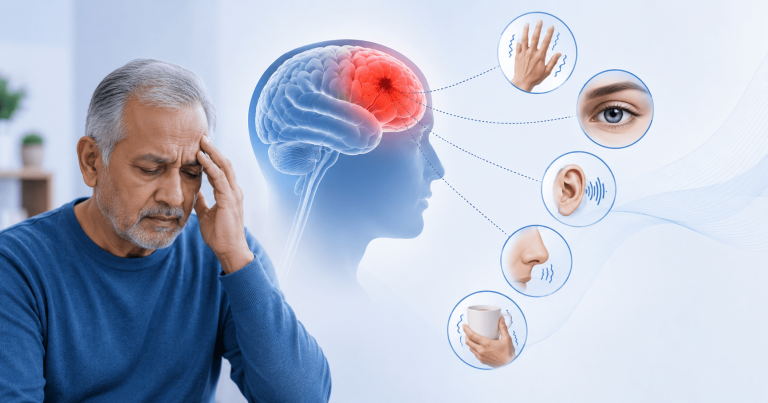
Depending on the brain area involved, stroke patients may experience:
- Numbness in the hand, arm, or leg
- Reduced awareness of body position
- Difficulty identifying objects by touch
- Poor balance while walking
- Sensitivity to touch or temperature
- Neglect of one side of the body
At our clinic, many patients don’t realize these symptoms are neurological—not muscular.
For example, a patient may have enough leg strength to walk but still feel unstable because their brain cannot properly process foot contact with the ground.
How Sensory Integration Affects Daily Life
Sensory loss impacts much more than movement.
Simple tasks become harder:
- Buttoning a shirt
- Holding a cup
- Walking on uneven surfaces
- Climbing stairs
- Writing
- Cooking safely
One of our stroke patients in Ahmedabad, a 54-year-old businessman, regained arm movement after 8 weeks but still struggled to hold a spoon properly. The issue wasn’t strength—it was sensory feedback.
Once sensory training began, his hand control improved significantly over the following weeks. This is why Sensory Integration Exercises For Stroke Patients are critical.
How Physiotherapy Uses Sensory Integration Exercises For Stroke Patients
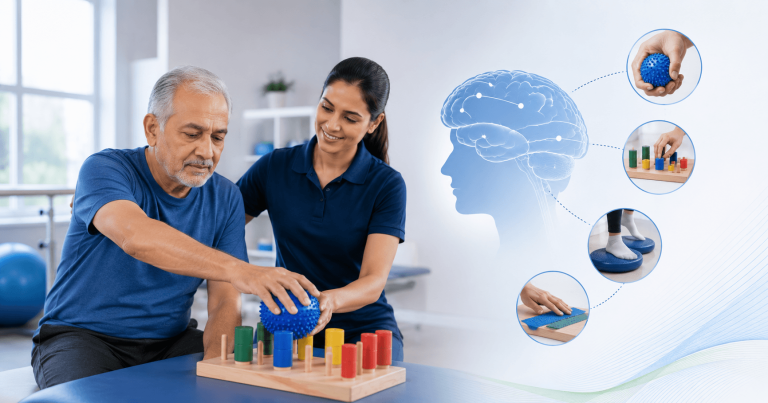
Physiotherapy combines sensory retraining with movement rehabilitation.
At Varia Physiotherapy Clinic, treatment starts with a detailed clinical assessment:
1. Sensory Mapping Assessment
We evaluate:
- Light touch sensation
- Deep pressure recognition
- Joint position sense
- Temperature awareness
- Vibration sensitivity
- Proprioception
This helps us understand how the nervous system is responding.
2. Texture Recognition Training
Patients are exposed to different surfaces:
- Soft cloth
- Rough towel
- Cotton
- Sandpaper
- Foam
This improves tactile discrimination. A patient may close their eyes and identify textures using touch alone.
These types of stroke sensory retraining exercises strengthen sensory pathways in the brain and improve touch recognition.
3. Weight-Bearing Exercises
Weight-bearing improves sensory input through joints.
Examples:
- Supported standing
- Leaning on affected arm
- Quadruped positioning
- Sit-to-stand drills
This helps improve:
- Joint awareness
- Muscle activation
- Balance control
This method is strongly supported in neurorehabilitation.
4. Mirror Therapy
Mirror therapy helps the brain reconnect visual and sensory feedback. A mirror is placed so the unaffected limb reflects movement, creating the illusion that the affected limb is moving normally. Research from the National Institutes of Health (NIH) supports mirror therapy in stroke rehabilitation for improving sensory and motor recovery.
5. Balance Surface Training
Patients practice on:
- Foam surfaces
- Balance boards
- Uneven mats
This challenges sensory adaptation. It helps the brain better interpret body position during standing and walking.
At Varia, we integrate this into our stroke recovery rehabilitation program for better functional outcomes.
6. Object Recognition Exercises
Patients identify:
- Coins
- Keys
- Pens
- Buttons
Without looking. This retrains stereognosis (object recognition through touch). It improves hand function in real life.
Real Patient Scenario from Varia Physiotherapy Clinic
A 62-year-old woman from Ahmedabad came to us after a left-brain stroke.
Her main complaint:
“My right leg feels like it is floating.”
She could walk with support but had frequent imbalance.
Assessment showed:
- Poor proprioception
- Reduced foot pressure awareness
- Delayed weight shifting
Her treatment plan included:
- Sensory stimulation
- Weight-bearing drills
- Surface walking
- Visual feedback exercises
After 6 weeks:
- Standing confidence improved
- Walking speed increased
- Falls reduced
- Stair climbing became safer
Her recovery was gradual—not immediate—but meaningful. This reflects real stroke rehabilitation.
Common Myths vs Facts About Sensory Recovery
Myth: If movement returns, sensation will return automatically.
Fact: Sensory recovery often needs separate rehabilitation.
Myth: Numbness after stroke is permanent.
Fact: Many patients improve with guided therapy.
Myth: Only speech and walking therapy matter.
Fact: Sensory retraining affects balance, coordination, and independence.
Myth: Recovery stops after 3 months.
Fact: Neuroplasticity can continue for months or years with consistent training.
When Should You See a Physiotherapist?
Seek physiotherapy if you notice:
Persistent numbness
If part of your body continues to feel numb or “different” after a stroke, it may affect how safely you move and perform daily tasks. A physiotherapy assessment can help identify whether sensory retraining is needed.
Balance problems
Feeling unsteady while standing or walking is common after a stroke and can increase the risk of falls. Early therapy can improve body awareness and help rebuild confidence in movement.
Frequent falls
Repeated falls are not something to ignore. They often signal reduced coordination, poor sensory feedback, or muscle weakness that needs professional rehabilitation.
Difficulty holding objects
If you struggle to grip a spoon, cup, or pen even after regaining movement, the issue may be sensory control rather than strength alone. Targeted exercises can help improve hand function.
Poor coordination
When movements feel clumsy, slow, or difficult to control, it may indicate the brain is still relearning how to process movement and sensation together. Physiotherapy helps improve this connection.
Walking hesitation
If you feel unsure or fearful while taking steps, especially on uneven surfaces or stairs, sensory and balance training can help improve stability and reduce walking anxiety.
Early rehabilitation often improves outcomes. At Varia Physiotherapy Clinic, we recommend early assessment within the first few weeks after stroke when possible. However, even chronic stroke patients can benefit.
When Referral to a Neurologist May Be Needed
Physiotherapy is important, but some cases require specialist referral.
See a neurologist if:
- Sensory symptoms worsen suddenly
- New weakness appears
- Severe spasticity develops
- Seizures occur
- Cognitive decline increases
We work alongside neurologists and orthopedic specialists when needed. This team-based approach improves patient safety.
Realistic Recovery Timeline
Stroke recovery is different for every person.
Typical sensory improvement timelines:
Recovery depends not just on exercises, but on doing the right exercises at the right time. Clinically guided physiotherapy reduces re-injury risk and helps restore confidence, strength, and control safely.
2–6 Weeks: Basic Sensory Awareness May Improve
In the early stage of recovery, many stroke patients begin noticing small but meaningful changes, like feeling touch more clearly or becoming more aware of where their hand or foot is placed. This stage focuses on helping the brain reconnect with basic sensory signals through guided physiotherapy.
6–12 Weeks: Better Balance and Limb Positioning
As therapy continues, patients often develop better body awareness, which can improve standing balance and reduce the fear of falling. During this phase, physiotherapists work on safe weight shifting, posture correction, and controlled movement patterns for daily activities.
3–6 Months: Improved Functional Control
At this stage, many patients start using the affected arm or leg more naturally in routine tasks like walking, holding objects, or getting dressed. Progress depends on consistency, but structured sensory and movement training can improve independence and confidence significantly.
6–12 Months: Advanced Coordination Gains
Recovery in this phase often focuses on refining movement quality, coordination, and adapting to more complex activities like stair climbing or outdoor walking. Even though progress may feel slower, continued rehabilitation can still create important improvements through ongoing neuroplasticity.
Recovery depends on:
- Stroke severity
- Brain area involved
- Age
- Therapy consistency
- Overall health
No ethical clinic should promise “fast cures. Progress is built over time.
Conclusion
Recovery after a stroke is not just about movement—it is about reconnecting the brain and body. Sensory Integration Exercises For Stroke Patients help rebuild awareness, balance, coordination, and confidence in daily life.
At Varia Physiotherapy Clinic in Ahmedabad, we focus on real recovery—not quick promises. Every stroke patient deserves a treatment plan based on careful assessment, realistic goals, and evidence-based rehabilitation.
If you or your loved one is struggling with numbness, imbalance, or poor coordination after stroke, early physiotherapy can make a meaningful difference.
Book an assessment and understand what your recovery truly needs.
Book a Professional Assessment
If you’re unsure whether your symptoms need attention, it’s okay to start with a simple consultation. Understanding your condition is the first step toward recovery—no pressure, just guidance.
If you’d like to speak with a physiotherapist or book an assessment at Varia Physiotherapy Clinic, you can reach out here:
 Call: +91 95123 79555
 Email: hello.drhetalvaria@gmail.com
 Website: www.variaphysiotherapyclinic.com
Our team is here to listen, assess, and guide you toward safe and effective recovery.
Sensory Integration Exercises For Stroke Patients - FAQs
1. Are sensory integration exercises painful?
2. How often should stroke patients do sensory exercises?
3. Can sensory exercises improve walking?
4. How long before results appear?
5. Can old stroke patients still improve?
About the Author

Dr. Hetal M Varia
After a rich experience of working in US healthcare as manager and licensed physiotherapist in US for last 11 years, she has returned home with a vision to become pioneer of Vestibular Therapy and specialized Parkinson physiotherapy in Ahmedabad. With her special skills and expertise in vertigo, Parkinson, balance and movement disorders therapy, Dr. Varia is committed to provide US standards of therapy services , compassionate and patient centered care to our people and community. With a vision of the world where everyone walks strong & steady, she intends to empower individuals with vestibular and neurological disorders through specialized care, rehabilitation & innovative therapies to improve mobility, balance & overall quality of life!