
Communication Skill Recovery After Stroke | Speech Therapy & Rehab Guide
Stroke recovery is often talked about in terms of walking again, moving the arm again, or regaining balance. But one of the most emotionally difficult challenges many patients face is losing the ability to communicate.
At the World Health Organization, stroke is recognized as one of the leading causes of long-term disability worldwide. Among those disabilities, speech and communication problems can deeply affect independence, relationships, and mental well-being.
At Varia Physiotherapy Clinic, we often meet stroke patients and families who say:
“He understands everything, but he cannot express it.”
“She wants to speak, but the words don’t come out.”
“His speech has become unclear after the stroke.”
These situations are common.
Communication Skill Recovery After Stroke is not just about speaking words again. It involves rebuilding language understanding, speech clarity, memory, confidence, and social connection.
Recovery takes time. Some patients improve within weeks, while others need months of structured rehabilitation. With the right combination of physiotherapy, speech therapy, and neurological rehab, meaningful progress is possible.
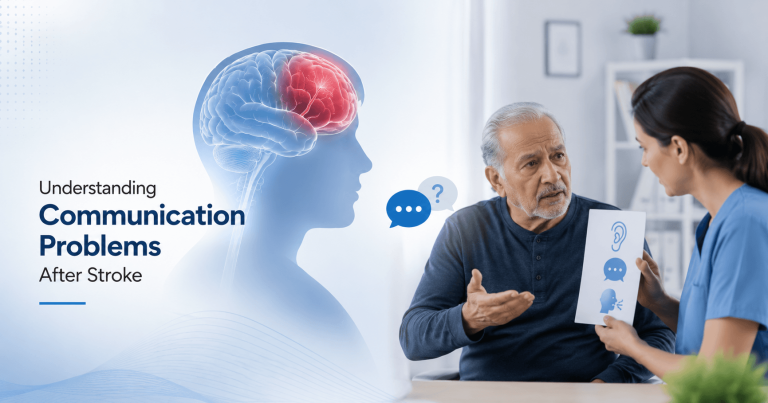
Understanding Communication Problems After Stroke
A stroke happens when blood flow to the brain is interrupted. If the stroke affects areas responsible for speech and language, communication can become difficult.
The brain areas commonly affected include:
- Broca’s area – affects speaking and forming words
- Wernicke’s area – affects understanding language
- Motor cortex – affects muscles used for speech
- Cognitive centers – affects memory and attention
This can lead to:
1. Aphasia
Aphasia can make it difficult for a person to express thoughts or understand what others are saying after a stroke. Many patients know exactly what they want to say, but finding the right words can feel frustrating and exhausting.
2. Dysarthria
Dysarthria happens when the muscles used for speaking become weak or less coordinated after a stroke. This can make speech sound slurred, soft, or unclear, even when the person knows what they want to communicate.
3. Apraxia of Speech
Apraxia of speech affects the brain’s ability to plan and coordinate the movements needed for speaking. A person may struggle to say words correctly, even though their mouth muscles are physically strong enough to do so.
Example:
The person may say the wrong sounds repeatedly. According to the National Institutes of Health, nearly one-third of stroke survivors experience some form of communication impairment. That’s why early rehabilitation matters.
Communication Skill Recovery After Stroke: Why Early Rehab Matters
At Varia Physiotherapy Clinic, one pattern we consistently observe is this:
Patients who begin rehabilitation earlier often show better adaptation. This doesn’t mean delayed recovery is impossible—but early intervention helps the brain take advantage of neuroplasticity.
Neuroplasticity means the brain can reorganize itself and create new pathways after injury. This is the foundation of Communication Skill Recovery After Stroke.
The first 3–6 months are especially important, but recovery can continue even beyond a year.
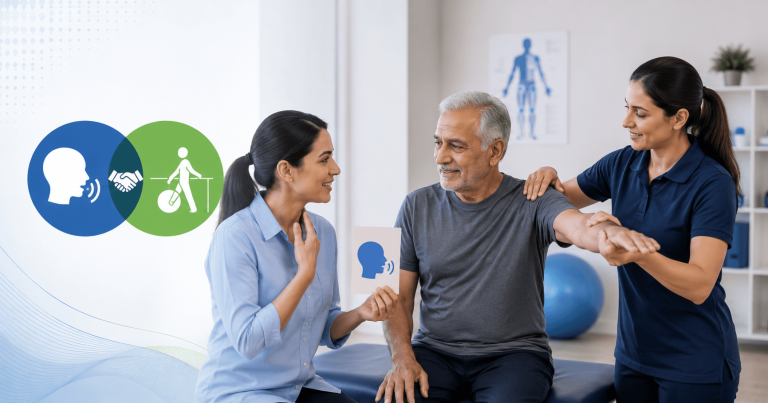
How Speech Therapy and Physiotherapy Work Together
Many people assume speech recovery only needs speech therapy. That’s incomplete. Stroke affects the entire nervous system. Communication depends on posture, breathing, facial muscle control, attention, and coordination. This is where physiotherapy supports speech recovery as part of a stroke recovery rehabilitation program designed to address both physical and neurological aspects of recovery together.
1. Postural Control Training
Good posture improves:
- Breathing efficiency
- Voice production
- Swallowing safety
- Facial muscle coordination
At our clinic, patients with weak trunk control often struggle to maintain enough breath support for speech. Physiotherapy helps stabilize the body first.
2. Respiratory Strengthening
Speech depends on airflow.
Weak breathing muscles can reduce:
- Voice volume
- Sentence length
- Speech clarity
Exercises may include:
- Diaphragmatic breathing
- Controlled exhalation
- Breath-hold training
- Incentive spirometry
This improves vocal endurance.
3. Orofacial Muscle Exercises
These target:
- Lips
- Tongue
- Jaw
- Cheeks
Useful for:
- Slurred speech
- Poor articulation
- Drooling
- Swallowing difficulty
Evidence-based techniques include resistance and repetition drills.
4. Cognitive-Motor Rehabilitation
Many stroke patients also have:
- Poor concentration
- Delayed processing
- Memory challenges
We combine movement with mental tasks such as:
- Naming objects while walking
- Following commands during balance training
- Memory recall during hand exercises
This strengthens multiple brain networks together.
Step-by-Step Communication Skill Recovery After Stroke
Step 1: Detailed Assessment
At Varia Physiotherapy Clinic, we assess:
- Speech clarity
- Muscle strength
- Facial symmetry
- Breathing pattern
- Swallowing safety
- Balance and mobility
- Cognitive function
If needed, we coordinate with neurologists or speech-language pathologists.
Step 2: Individual Treatment Planning
No two strokes are the same, and neither is the recovery journey. Each patient’s progress depends on how the brain is affected, their physical condition, and how consistently rehabilitation is followed.
Treatment depends on:
- Stroke location
- Severity
- Time since stroke
- Age
- Existing health conditions
A personalized plan improves outcomes.
Step 3: Repetitive Functional Practice
Recovery after stroke depends heavily on repetition. The brain strengthens new pathways through consistent, repeated practice over time.
Examples:
- Practicing simple words daily
- Reading aloud
- Breathing while speaking
- Naming family members
- Structured conversation tasks
Consistency matters more than intensity.
Step 4: Family Involvement
Family support plays a key role in stroke recovery, especially in communication and daily rehabilitation. A supportive environment helps patients stay motivated and engaged in therapy.
We guide caregivers to:
- Speak slowly
- Use simple sentences
- Allow time for response
- Avoid correcting aggressively
- Encourage communication attempts
This reduces frustration.
A Common Patient Story We Often See
A 58-year-old businessman from Ahmedabad came to us three weeks after an ischemic stroke. His right side was weak. His speech was slow and unclear. He understood conversations but struggled to answer. His family feared permanent speech loss.
After assessment, we identified:
- Mild aphasia
- Dysarthria
- Weak trunk stability
- Reduced breath support
His rehab plan included:
- Balance retraining
- Breathing exercises
- Facial muscle stimulation
- Guided speech drills
- Walking with verbal task practice
Within six weeks:
- His speech became clearer
- He could complete short sentences
- His confidence improved
- Family communication became easier
This is a realistic example of gradual, meaningful recovery—not an instant cure.
Myths vs Facts About Stroke Communication Recovery
Myth | Fact |
Speech recovery happens automatically | Structured therapy improves outcomes |
If recovery doesn’t happen in 3 months, it’s over | Recovery can continue for years |
Speech therapy alone is enough | Whole-body rehabilitation supports speech |
Slurred speech is always permanent | Many patients improve with practice |
Older patients recover poorly | Age affects speed, not possibility |
When Should You See a Physiotherapist?
Seek help if after stroke you notice:
- Slurred speech
- Difficulty finding words
- Weak facial muscles
- Choking while eating
- Poor sitting balance
- Weakness in limbs
- Confusion during communication
Immediate referral to a neurologist may be needed if symptoms suddenly worsen. An orthopedic consultation may be required if joint stiffness or pain limits rehab. Do not delay assessment.
Realistic Recovery Timelines
Recovery depends on severity.
General timelines:
Mild communication impairment:
Recovery often improves within 4–12 weeks with consistent therapy and practice. Many patients regain clear, functional communication during daily conversations in this phase.
Moderate impairment:
Recovery may take around 3–6 months, depending on stroke severity and rehabilitation consistency. Progress is steady but needs regular guided therapy and family support.
Severe impairment:
Recovery can take 6–18 months or longer, and in some cases continues gradually beyond this period. Improvement is possible, but it requires long-term, structured rehabilitation and patience.
Recovery after a stroke is rarely a straight path. Some weeks feel like major progress, while others may feel slower or challenging. This variation is normal and reflects how the brain rebuilds communication pathways over time.
Conclusion
Communication Skill Recovery After Stroke is often one of the most emotional parts of healing. It affects identity, relationships, work, and independence. But improvement is possible.
At Varia Physiotherapy Clinic, we focus on structured, evidence-based rehabilitation designed around each patient’s condition, goals, and recovery stage.
If you or a loved one is struggling with speech, understanding, or communication after stroke, an early assessment can help identify the right next steps.
Recovery may take time—but every word regained matters.
Book a Professional Assessment
If you’re unsure whether your symptoms need attention, it’s okay to start with a simple consultation. Understanding your condition is the first step toward recovery—no pressure, just guidance.
If you’d like to speak with a physiotherapist or book an assessment at Varia Physiotherapy Clinic, you can reach out here:
 Call: +91 95123 79555
 Email: hello.drhetalvaria@gmail.com
 Website: www.variaphysiotherapyclinic.com
Our team is here to listen, assess, and guide you toward safe and effective recovery.
Communication Skill Recovery - FAQs
1. Can communication fully recover after a stroke?
2. How soon should speech therapy start?
3. Does physiotherapy help speech recovery?
4. What if my family member understands but cannot speak?
5. Can home exercises help?
About the Author

Dr. Hetal M Varia
After a rich experience of working in US healthcare as manager and licensed physiotherapist in US for last 11 years, she has returned home with a vision to become pioneer of Vestibular Therapy and specialized Parkinson physiotherapy in Ahmedabad. With her special skills and expertise in vertigo, Parkinson, balance and movement disorders therapy, Dr. Varia is committed to provide US standards of therapy services , compassionate and patient centered care to our people and community. With a vision of the world where everyone walks strong & steady, she intends to empower individuals with vestibular and neurological disorders through specialized care, rehabilitation & innovative therapies to improve mobility, balance & overall quality of life!