
Physiotherapy For Sensory Balance Disorders
Balance problems can affect far more than walking. Many adults living with sensory balance disorders describe feeling uncertain while standing, dizzy in crowded places, unstable on uneven surfaces, or anxious about falling during daily activities. At Varia Physiotherapy Clinic in Ahmedabad, we frequently meet patients between the ages of 30 and 65 who struggle with these symptoms while managing work, family responsibilities, and an active lifestyle.
Physiotherapy For Sensory Balance Disorders focuses on improving the body’s ability to process movement, posture, and spatial awareness safely and effectively. Rather than simply treating symptoms, physiotherapy aims to identify the underlying causes contributing to imbalance and dizziness.
Some patients develop symptoms gradually after prolonged neck pain or sedentary work habits. Others experience sudden imbalance following viral infections, neurological conditions, inner ear disturbances, or age-related changes. Regardless of the cause, individualized physiotherapy can often help patients improve mobility, reduce fear of falling, and regain confidence in daily activities.
Understanding Sensory Balance Disorders in Simple Terms
The body relies on three major systems to maintain balance:
- The inner ear (vestibular system) detects movement and head position.
- The eyes (visual system) help the brain understand surroundings.
- The muscles and joints (proprioceptive system) provide feedback about body position.
When one or more of these systems are not working efficiently together, people may experience:
- Dizziness or unsteadiness
- Swaying while standing
- Difficulty walking in crowded environments
- Motion sensitivity
- Loss of confidence during movement
- Increased risk of falls
- Neck tightness associated with dizziness
- Fatigue during daily activities
According to the World Health Organization, balance impairments and falls are a significant health concern in adults and older populations worldwide. The World Health Organization Fall Prevention Resources highlight how balance rehabilitation and movement-based care can help reduce fall risks.
Similarly, the National Institutes of Health emphasizes that vestibular and neurological rehabilitation can improve functional independence and quality of life in patients with balance disorders. NIH Balance Disorders Information

Common Causes That Lead Patients to Seek Physiotherapy For Sensory Balance Disorders
At Varia Physiotherapy Clinic, patients commonly present with a combination of physical and neurological factors contributing to imbalance.
Vestibular Dysfunction
Vestibular dysfunction affects the inner ear system responsible for balance and movement awareness. Patients may feel dizzy while turning quickly, bending forward, or walking in crowded or visually busy environments. Physiotherapy focuses on improving gaze stability, movement confidence, and motion tolerance through evidence-based vestibular rehabilitation exercises tailored to the individual’s symptoms.
Cervical Spine Problems
Neck stiffness, poor posture, and prolonged desk work can influence body awareness and balance control. Many people experience dizziness or unsteadiness alongside neck pain, especially during head movement or extended screen use. Physiotherapy aims to improve cervical mobility, posture, muscle coordination, and proprioception to help reduce these symptoms safely.
Neurological Conditions
Conditions such as stroke, Parkinson’s disease, and peripheral neuropathy can affect coordination, walking stability, and muscle control. Patients may notice slower movement, balance difficulties, or increased fear of falling during daily activities. Physiotherapy focuses on safe functional rehabilitation, mobility training, and improving independence based on the patient’s neurological condition and recovery goals.
Age-Related Balance Decline
Natural age-related changes in muscle strength, joint flexibility, reaction time, and sensory processing can gradually affect balance and walking confidence. Many adults begin limiting activities due to fear of falling, which may further reduce mobility over time. Physiotherapy helps improve stability, strength, coordination, and confidence through structured balance training programs.
Post-Viral or Post-Infection Dizziness
Some individuals continue experiencing dizziness, imbalance, or motion sensitivity after recovering from viral illnesses. Symptoms may include brain fog, walking instability, fatigue, or difficulty tolerating movement in busy environments. Physiotherapy uses gradual vestibular and balance rehabilitation techniques to support recovery and help patients return to normal daily activities safely.

How Physiotherapy Helps Step by Step
A people-first approach to physiotherapy for dizziness and balance problems begins with understanding how symptoms affect the patient’s real life and daily mobility.
1. Comprehensive Clinical Assessment
At Varia Physiotherapy Clinic, assessment may include:
- Balance and gait evaluation
- Vestibular function screening
- Neck mobility testing
- Postural analysis
- Strength and coordination assessment
- Fall-risk evaluation
- Functional movement observation
This helps determine whether symptoms are primarily vestibular, musculoskeletal, neurological, or a combination of factors.
In some situations, referral to an orthopedic specialist, ENT doctor, or neurologist may be recommended if symptoms suggest underlying medical conditions requiring additional investigation.
2. Vestibular Rehabilitation Exercises
Vestibular rehabilitation is an evidence-based physiotherapy approach used to retrain the brain and body to process movement more efficiently.
Exercises may include:
- Gaze stabilization exercises
- Head movement coordination
- Motion sensitivity training
- Visual tracking activities
- Habituation exercises
Initially, these exercises may temporarily provoke mild symptoms, which is a normal part of adaptation. Gradual progression helps improve tolerance over time.
3. Balance and Proprioception Training
Patients practice controlled movements to improve body awareness and stability.
Examples include:
- Weight-shifting exercises
- Single-leg balance training
- Surface stability exercises
- Walking coordination drills
- Dynamic balance activities
These exercises are progressed carefully based on safety and confidence levels.
4. Neck Mobility and Posture Correction
For patients with cervicogenic dizziness or postural strain, physiotherapy may include:
- Gentle manual therapy
- Neck mobility exercises
- Deep cervical muscle activation
- Postural correction strategies
- Ergonomic guidance for desk workers
Many patients notice improvements when neck tension and movement restrictions are addressed appropriately.
5. Strengthening and Functional Rehabilitation
Weakness in the hips, core, and lower limbs can worsen instability. Strength training helps improve movement efficiency and reduce compensatory patterns.
Treatment often includes:
- Core stability exercises
- Lower limb strengthening
- Functional sit-to-stand training
- Stair and walking practice
- Endurance conditioning
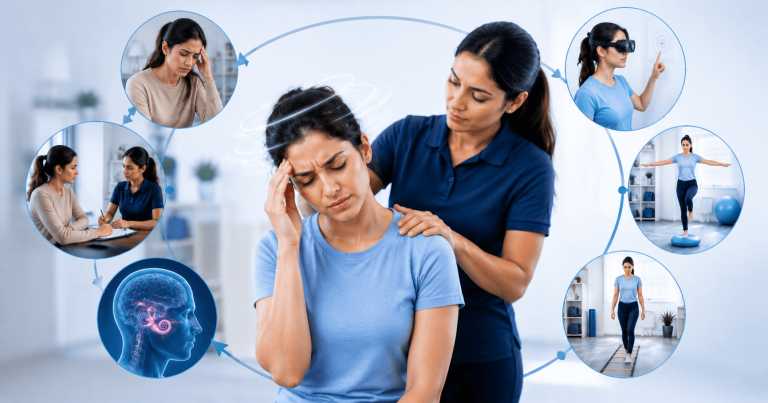
A Real Patient Scenario Commonly Seen in Clinic
A 48-year-old office professional visited Varia Physiotherapy Clinic after experiencing persistent unsteadiness for nearly four months. She described feeling “off balance” while walking in shopping malls and during prolonged computer work.
Initially, she believed the problem was solely related to stress. However, clinical assessment revealed a combination of neck stiffness, poor posture, vestibular sensitivity, and reduced balance confidence.
Her treatment plan included:
Vestibular Rehabilitation Exercises
Vestibular rehabilitation exercises help patients improve balance, gaze stability, and motion tolerance by gradually training the brain and inner ear system to process movement more effectively.
Cervical Mobility Therapy
Cervical mobility therapy focuses on improving neck movement, reducing stiffness, and restoring proper muscle function that may contribute to dizziness or postural imbalance.
Postural Retraining
Postural retraining helps patients develop better body alignment and movement habits, especially during prolonged sitting, standing, or screen use that may worsen balance-related symptoms.
Balance Exercises
Balance exercises are designed to improve stability, coordination, and confidence during daily activities while reducing the risk of falls and movement-related anxiety.
Gradual Walking Exposure Training
Gradual walking exposure training helps patients safely rebuild walking confidence by slowly increasing movement tolerance in different environments and daily situations.
Over approximately eight weeks, she reported improved walking confidence, reduced dizziness during movement, and less fear while navigating crowded places.
Recovery timelines vary depending on the underlying condition, symptom duration, and patient consistency with exercises. Some individuals improve within a few weeks, while neurological conditions may require longer-term rehabilitation.
Myths vs Facts About Balance Disorders
Myth | Fact |
“Dizziness always means a serious brain problem.” | Many balance issues are related to vestibular dysfunction, posture, or sensory processing changes. |
“Rest is the best solution.” | Excessive inactivity can sometimes worsen balance confidence and mobility. |
“Balance problems only affect older adults.” | Adults in their 30s–50s may also experience sensory balance disorders. |
“Physiotherapy only helps muscle pain.” | Physiotherapy also supports vestibular and neurological rehabilitation. |
“Recovery should happen immediately.” | Balance retraining typically requires gradual adaptation and consistent practice. |
When Should You See a Physiotherapist?
You should consider professional assessment if you experience:
- Frequent unsteadiness while walking
- Dizziness with head movement
- Fear of falling
- Motion sensitivity
- Difficulty navigating busy environments
- Neck-related dizziness
- Recurrent imbalance after illness
- Reduced confidence during movement
Seek immediate medical evaluation if dizziness is associated with:
- Sudden severe headache
- Facial weakness
- Speech difficulty
- Loss of consciousness
- Chest pain
- Sudden neurological changes
These symptoms may require urgent medical care rather than physiotherapy alone.
Final Clinical Advice
Living with dizziness or instability can be physically and emotionally exhausting. Many patients begin avoiding social activities, exercise, travel, or even routine daily tasks because they no longer trust their balance.
A structured physiotherapy approach can help address the physical factors contributing to imbalance while gradually rebuilding movement confidence. At Varia Physiotherapy Clinic in Ahmedabad, treatment plans are tailored to each patient’s condition, functional goals, and recovery pace.
If you or a family member has been experiencing persistent dizziness, instability, or reduced balance confidence, an early physiotherapy assessment may help identify contributing factors and guide appropriate rehabilitation safely and ethically.
Book a Professional Assessment
If you’re unsure whether your symptoms need attention, it’s okay to start with a simple consultation. Understanding your condition is the first step toward recovery—no pressure, just guidance.
If you’d like to speak with a physiotherapist or book an assessment at Varia Physiotherapy Clinic, you can reach out here:
 Call: +91 95123 79555
 Email: hello.drhetalvaria@gmail.com
 Website: www.variaphysiotherapyclinic.com
Our team is here to listen, assess, and guide you toward safe and effective recovery.
Physiotherapy For Sensory Balance Disorders - FAQs
Can physiotherapy really help balance disorders?
How long does recovery take?
Are vestibular exercises safe?
Can neck problems cause dizziness?
Will I need scans or medical tests?
About the Author

Dr. Hetal M Varia
After a rich experience of working in US healthcare as manager and licensed physiotherapist in US for last 11 years, she has returned home with a vision to become pioneer of Vestibular Therapy and specialized Parkinson physiotherapy in Ahmedabad. With her special skills and expertise in vertigo, Parkinson, balance and movement disorders therapy, Dr. Varia is committed to provide US standards of therapy services , compassionate and patient centered care to our people and community. With a vision of the world where everyone walks strong & steady, she intends to empower individuals with vestibular and neurological disorders through specialized care, rehabilitation & innovative therapies to improve mobility, balance & overall quality of life!