
Vestibular Migraine Rehabilitation In Ahmedabad
Living with repeated episodes of vertigo, dizziness, or a sudden spinning sensation can make everyday life exhausting. Many adults in Ahmedabad struggle silently with migraine-associated vertigo, unsteady walking, head movement dizziness, and motion sensitivity without realizing that these symptoms may be linked to a vestibular migraine. At Varia Physiotherapy Clinic, patients often describe feeling anxious while walking in crowded markets, climbing stairs, driving, or even turning quickly in bed because of chronic vertigo and balance instability.
Vestibular migraine is more than just a headache. It affects the vestibular system, which controls equilibrium, coordination, walking stability, and spatial orientation. Some people experience migraine vertigo without severe headache pain, making diagnosis confusing and delayed.
Fortunately, evidence-based vestibular migraine rehabilitation in Ahmedabad can help improve balance confidence, reduce dizziness episodes, and support long-term mobility improvement through targeted physiotherapy treatment and neurological rehabilitation.
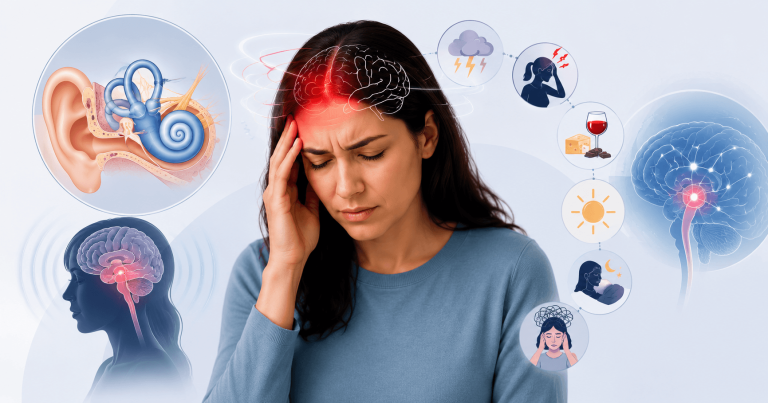
Understanding Vestibular Migraine in Simple Terms
A vestibular migraine is a neurological balance disorder where migraine activity affects the inner ear and brain pathways responsible for balance and movement coordination. This can lead to:
Dizziness
Dizziness can feel like lightheadedness, floating, or difficulty focusing during daily activities. Many patients notice symptoms while standing up, walking in crowded places, or changing head positions. A proper assessment helps identify whether the issue is related to the vestibular system, migraine, neck dysfunction, or another neurological condition.
Visual Vertigo
Visual vertigo happens when busy environments like traffic, shopping malls, scrolling on screens, or moving objects trigger discomfort or imbalance. Patients often describe feeling overwhelmed, disoriented, or uneasy in visually stimulating surroundings. Vestibular rehabilitation can help the brain gradually tolerate these situations more comfortably.
Unsteady Walking
Unsteady walking may cause a person to feel unsafe while turning, climbing stairs, or walking on uneven surfaces. Many adults begin limiting movement because of fear of falling, which can further reduce confidence and mobility. Physiotherapy focuses on balance retraining, coordination, and walking stability to improve daily function safely.
Nausea with Dizziness
Nausea with dizziness is common in vestibular migraine and other balance disorders, especially during sudden movement or travel. Some patients experience discomfort severe enough to avoid social outings or work activities. Treatment aims to reduce symptom triggers while improving movement tolerance gradually.
Head Movement Dizziness
Head movement dizziness occurs when turning, bending, or looking upward triggers spinning sensations or imbalance. Patients may notice symptoms during simple tasks like getting out of bed or checking blind spots while driving. Vestibular exercises and gaze stabilization techniques can help improve adaptation over time.
Motion Sensitivity
Motion sensitivity causes discomfort during travel, quick movements, crowded environments, or even watching moving screens. Many individuals feel exhausted because their brain struggles to process movement and visual information together. Evidence-based vestibular rehabilitation helps improve sensory integration and movement confidence progressively.
Postural Imbalance
Postural imbalance affects the body’s ability to stay stable while standing, walking, or changing positions. Patients may lean, sway, or feel uncertain during movement, especially in low-light or busy environments. A personalized physiotherapy program can help strengthen balance reactions, posture control, and overall mobility confidence.
Many patients also complain of difficulty focusing in busy environments, discomfort while watching moving objects, and reduced balance confidence during daily activities.
Unlike common migraines, vestibular migraine symptoms may occur with or without headache. Because symptoms overlap with other vestibular disorders and inner ear dysfunction conditions, proper clinical assessment becomes extremely important.
The World Health Organization emphasizes the importance of rehabilitation and mobility support in neurological conditions affecting quality of life. Similarly, the National Institutes of Health highlights vestibular rehabilitation as an effective approach for dizziness management and balance improvement.
Common Causes and Triggers Patients Experience
At Varia Physiotherapy Clinic, many adults between 30 and 65 report symptoms worsening because of:
- Stress and irregular sleep
- Long work hours on screens
- Sudden head movements
- Bright lights or loud environments
- Hormonal fluctuations
- Previous migraine history
- Reduced physical activity
- Poor posture and neck stiffness
- Sensory overload in crowded environments
Some patients initially think they have cervical problems, low blood pressure, or general weakness. However, vestibular migraine often involves disturbances in the vestibulo-ocular reflex, sensory integration, and postural control mechanisms.
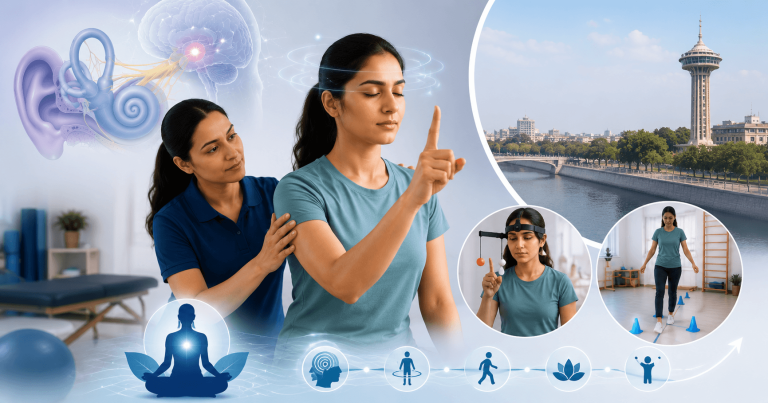
How Vestibular Migraine Rehabilitation In Ahmedabad Helps
Vestibular migraine rehabilitation in Ahmedabad focuses on retraining the brain and body to process balance signals more efficiently. Physiotherapy does not simply “stop dizziness instantly.” Instead, it supports gradual vestibular compensation and nervous system adaptation through structured rehabilitation exercises.
1. Detailed Clinical Assessment
A vestibular physiotherapist first evaluates:
- Balance dysfunction
- Gait stability
- Coordination training needs
- Visual vertigo triggers
- Walking stability
- Neck posture
- Eye movement control
- Motion sensitivity
- Fall prevention risk
- Head movement dizziness patterns
Assessment may include balance therapy tests, vestibulo-ocular reflex evaluation, gait observation, and postural control analysis. If symptoms suggest severe neurological issues, sudden hearing loss, or other medical concerns, referral to a neurologist or ENT specialist may be recommended.
Balance Retraining and Stability Training
Many patients gradually avoid movement because they fear dizziness episodes. Unfortunately, reduced movement can worsen balance instability over time, which is why seeking professional vestibular rehabilitation support can help individuals safely rebuild balance confidence, improve mobility, and return to daily activities more comfortably.
Balance retraining exercises are designed to improve:
- Stability training
- Mobility rehabilitation
- Walking confidence
- Coordination
- Equilibrium responses
- Balance improvement
- Postural control
- Fall prevention
Therapists may begin with simple standing tasks and later progress to dynamic movement therapy and walking activities.
Gaze Stabilization and Vestibular Exercises
A common issue in vestibular migraine is difficulty stabilizing vision during head movement. Patients may feel the environment is bouncing or shifting.
Gaze stabilization exercises help train the vestibulo-ocular reflex so the eyes and vestibular system work together more effectively.
These vestibular exercises may include:
- Controlled head turns
- Visual tracking activities
- Eye-head coordination drills
- Habituation therapy
- Sensory integration activities
Over time, these rehabilitation exercises can reduce movement-triggered dizziness and improve dizziness recovery during daily tasks.
Habituation Therapy for Motion Sensitivity
Some patients experience severe discomfort while traveling, shopping, scrolling on phones, or moving through crowded spaces. This is often linked to visual vertigo and sensory overload.
Habituation therapy uses repeated controlled exposure to triggering movements in a safe manner. The goal is gradual nervous system adaptation rather than avoidance.
This form of physical therapy can help reduce:
- Motion sensitivity
- Spinning sensation
- Nausea with movement
- Visual vertigo
- Migraine vertigo symptoms
Recovery timelines vary. Some patients notice changes within a few weeks, while others with chronic dizziness may require a longer recovery program.
Real Patient Scenario Commonly Seen at Varia Physiotherapy Clinic
A 42-year-old working professional from Ahmedabad visited Varia Physiotherapy Clinic after experiencing repeated dizziness episodes for almost eight months.
She described:
- Sudden spinning sensation while turning her head
- Unsteady walking in malls
- Nausea with dizziness during travel
- Fear of falling in crowded areas
- Increased migraine episodes during work stress
Initially, she believed it was only cervical pain. However, detailed vestibular care assessment revealed migraine-associated vertigo with balance dysfunction and visual motion sensitivity.
Her rehabilitation plan included:
- Gaze stabilization
- Balance therapy
- Vestibular exercises
- Posture correction
- Mobility improvement drills
- Coordination training
- Gradual exposure through habituation therapy
After several weeks of consistent neuro physiotherapy and home exercise adherence, she reported improved balance confidence, better walking stability, and reduced dizziness intensity. While occasional symptoms still occurred during high stress, her daily functioning improved significantly.
Myths vs Facts About Vestibular Migraine Rehabilitation
Myth: “Dizziness means complete bed rest is necessary.”
Fact: Prolonged inactivity can worsen balance dysfunction and reduce vestibular compensation.
Myth: “Vestibular migraine is only a headache problem.”
Fact: It can significantly affect the vestibular system, equilibrium, and mobility.
Myth: “Physiotherapy works immediately in one session.”
Fact: Neurological rehabilitation requires gradual adaptation and consistency.
Myth: “All vertigo comes from the ear only.”
Fact: Migraine activity, neurological factors, posture issues, and sensory integration problems can all contribute.
Myth: “If scans are normal, symptoms are imaginary.”
Fact: Many vestibular disorders involve functional nervous system disturbances that may not appear on imaging.
When Should You See a Vestibular Physiotherapist?
You should consider physiotherapy treatment if you experience:
- Recurrent dizziness
- Chronic vertigo
- Balance instability
- Head movement dizziness
- Walking instability
- Motion sensitivity
- Migraine-associated vertigo
- Postural imbalance
- Fear of falling
- Difficulty with coordination
- Persistent visual vertigo
Immediate medical consultation is necessary if symptoms involve:
- Sudden weakness
- Slurred speech
- Loss of consciousness
- Severe hearing loss
- Double vision
- Sudden neurological changes
These may require urgent neurologist evaluation.
Lifestyle Tips That Support Recovery
Along with vestibular migraine rehabilitation in Ahmedabad, patients are often advised to:
- Maintain regular sleep schedules
- Stay hydrated
- Reduce screen overload
- Manage stress levels
- Practice prescribed vestibular exercises consistently
- Avoid sudden head movements initially
- Improve posture correction habits
- Gradually increase physical activity
A combination of clinical rehabilitation and self-management usually provides the best long-term results.
Conclusion
Vestibular migraine symptoms can disrupt confidence, mobility, work performance, and daily life. However, with proper clinical assessment, evidence-based vestibular care, and structured rehabilitation exercises, many patients can experience meaningful balance improvement and dizziness recovery.
At Varia Physiotherapy Clinic, vestibular migraine rehabilitation in Ahmedabad focuses on realistic recovery, patient education, neurological rehabilitation, and long-term functional improvement rather than temporary symptom suppression alone.
If persistent dizziness, imbalance, or migraine vertigo is affecting your quality of life, seeking professional guidance early may help prevent worsening balance dysfunction and support safer mobility in daily activities.
Book a Professional Assessment
If you’re unsure whether your symptoms need attention, it’s okay to start with a simple consultation. Understanding your condition is the first step toward recovery—no pressure, just guidance.
If you’d like to speak with a physiotherapist or book an assessment at Varia Physiotherapy Clinic, you can reach out here:
 Call: +91 95123 79555
 Email: hello.drhetalvaria@gmail.com
 Website: www.variaphysiotherapyclinic.com
Our team is here to listen, assess, and guide you toward safe and effective recovery.
Vestibular Migraine Rehabilitation In Ahmedabad - FAQs
1. Can physiotherapy really help vestibular migraine?
2. How long does vestibular migraine recovery take?
3. Is vestibular migraine the same as regular vertigo?
4. Are vestibular exercises safe?
5. Can stress worsen dizziness symptoms?
About the Author

Dr. Hetal M Varia
After a rich experience of working in US healthcare as manager and licensed physiotherapist in US for last 11 years, she has returned home with a vision to become pioneer of Vestibular Therapy and specialized Parkinson physiotherapy in Ahmedabad. With her special skills and expertise in vertigo, Parkinson, balance and movement disorders therapy, Dr. Varia is committed to provide US standards of therapy services , compassionate and patient centered care to our people and community. With a vision of the world where everyone walks strong & steady, she intends to empower individuals with vestibular and neurological disorders through specialized care, rehabilitation & innovative therapies to improve mobility, balance & overall quality of life!