
Knee Pain Physiotherapy in Ahmedabad – Best Treatment Guide
In my clinical practice, the biggest mistake I see in patients with knee pain is panic after an MRI report.
A patient walks in with:
- “Grade 2 meniscus tear”
- “Early osteoarthritis”
- “Ligament degeneration”
They’ve already:
- Been advised injections or surgery immediately
- Taken painkillers for 2–3 months
- Stopped climbing stairs completely
- Tried random YouTube strengthening exercises
- Compared their recovery with a neighbour who “recovered in 10 days”
And they’re confused.
Most online articles fail because they:
- Jump straight to exercises
- List generic strengthening routines
- Ignore movement errors
- Don’t screen properly for red flags
Promise quick fixes
Knee pain is rarely just a “weak muscle” problem. It is usually a load management and movement control issue.
This guide is written to give clarity — not to push treatment. Our expert structured knee rehabilitation for better mobility approach ensures patients regain function safely and effectively.
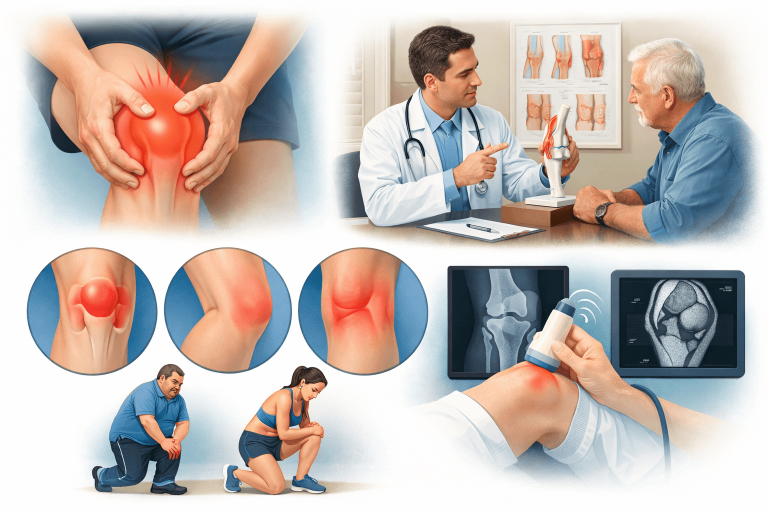
Real Knee Pain Patterns I See in Ahmedabad Clinics
1. MRI Overreaction
Many people get scans within the first week. But mild meniscus wear or cartilage thinning is common after 35 — even without pain.
Result:
- Fear of walking
- Avoiding stairs
- Belief that knee is permanently damaged
2. Sedentary + Weekend Overload Pattern
Common in:
- IT professionals
- CAs during tax season
- Business owners
Pattern:
5 days sitting → weekend intense walking or sports → flare-up. This is not “weak knee.” It’s poor load tolerance.
3. Social Media Rehab Confusion
Patients try:
- Deep squats immediately
- Heavy leg presses
- Random resistance band routines
Without understanding the pain irritability stage.
4. Over-Rest
Complete rest beyond acute inflammation phase reduces:
- Quadriceps strength
- Joint lubrication
- Confidence in movement
5. Unrealistic Timelines
Cartilage and tendon tissues adapt slowly.Expecting 2-week recovery from 8-month pain is unrealistic.
Recovery stalls because:
- Pain is flared repeatedly.
- Exercises are progressing too fast.
- Or not progressed at all.
- Pain is flared repeatedly.

Step-by-Step Clinical Action Plan
Step 1: Proper Diagnosis & Red Flag Screening
Before exercises, I screen for:
- Sudden swelling after trauma
- Locking knee
- Fever or infection signs
- Severe instability
- Progressive weakness
If suspected:
Immediate orthopedic referral. Not every knee pain is rehab-appropriate.
Step 2: Pain Control Without Passive Dependence
Initial goal: Reduce irritability.
We may use:
- Activity modification
- Short-term support taping
- Gentle isometrics
But we avoid:
- Long-term reliance on machines
- Repeated injections without load correction
- Only heat/massage approach
Pain control must transition into movement.
Step 3: Mobility Restoration
We assess:
- Ankle mobility
- Hip rotation
- Patellar tracking
- Knee extension deficit
Why it works:
Restricted joints above or below overload the knee.
Common mistake:
Forcing deep bending too early. Mobility must match tissue tolerance.
Step 4: Strength & Load Tolerance Development
Focus:
- Quadriceps endurance
- Hip abductors
- Hamstrings
- Controlled step-downs
Why:
Knee load increases during stairs and sitting transitions. Muscle endurance absorbs shock.
Mistake I often see:
Jumping from basic exercises to heavy gym squats. Progression must be staged.
Step 5: Functional Reintegration
For sedentary patients:
- Stair tolerance training
- Sit-to-stand repetition endurance
- Controlled walking progression
For active individuals:
- Gradual return-to-running protocol
- Agility progression
- Landing mechanics
Function > isolated exercise.
Step 6: Long-Term Relapse Prevention
Knee pain relapses when:
- Weight fluctuates drastically
- Exercise consistency drops
- Sleep and stress worsen
- Footwear is inappropriate
Tracking patterns prevents repeated flare-ups.

Real Ahmedabad Case Examples
Case 1: 46-Year-Old Chartered Accountant
Duration: 10 months knee pain
MRI: Early osteoarthritis
Stopped stairs completely — at this stage, it becomes important to find the right physiotherapy care for your condition to prevent further decline and gradually restore movement.
Failed Attempts:
- Painkillers
- Knee braces full-time
- Random YouTube squats
Treatment Plan:
- Education about safe loading
- Isometric strengthening
- Gradual step training
- Load progression over 12 weeks
Setback:
Flare-up during family function (excess walking)
Timeline:
Improvement in 4 weeks
Functional stair tolerance in 3 months
Outcome:
Not pain-free daily — but confident and active.
Case 2: 28-Year-Old Recreational Badminton Player
Goal:
Return to competitive play.
Problem:
Patellar tendon irritation.
Deficits:
Poor landing mechanics
Weak hip stabilizers
Plan:
- Load reduction
- Tendon isometric program
- Progressive plyometrics
Return to play:
10–12 weeks structured program.
Limitation:
Needs ongoing conditioning.
No miracle — just progressive loading.
Honest Patient Reflections
Business Owner, 50
“I thought osteoarthritis meant I should stop walking. Now I understand movement helps.”
Software Engineer, 32
“I kept trying harder exercises. Slowing down actually improved my knee.”
College Athlete, 21
“I expected a quick recovery. It took patience.”
Read More: How Long Does Physiotherapy Take To Work?
Clinical Credibility (What Evidence Actually Supports)
Modern knee rehab guidelines emphasize:
- Staying active
- Progressive strengthening
- Avoiding unnecessary imaging
- Avoiding prolonged passive treatment
Pain science shows:
Structural findings don’t always equal pain severity.
Practically:
Movement must be dosed, not avoided.
Who This Guide Is Not For
This guide is NOT for:
- Suspected fracture
- Severe ligament tear with instability
- Infection
- Rapid swelling post-trauma
- Progressive neurological deficit
- People expecting instant relief
This does NOT:
- Replace diagnosis
- Provide medication advice
- Guarantee recovery
- Replace in-person evaluation
Boundaries protect patients.
If I Were Treating This Today
I would prioritize:
- Accurate assessment
- Education about load
- Controlled progression
I would avoid:
- Aggressive deep squats early
- Over-reliance on machines
- Fear-based language
One mistake I see repeatedly:
Patients jumping stages.
One red flag I never ignore:
Mechanical locking with swelling.
I refer when:
- Suspected structural tear
- No improvement after staged rehab
- Worsening instability
Clinical judgment matters more than exercise count.
Conclusion
If you have knee pain in Ahmedabad:
Do:
- Seek proper screening
- Stay active within tolerance
- Progress gradually
- Track symptoms
Avoid:
- Panic after MRI
- Total rest
- Random online exercises
- Comparing your timeline to others
Consider using a structured rehab checklist or self-assessment tool to understand your stage before progressing. Clarity reduces fear. Structured progression reduces relapse.
Knee Pain Physiotherapy in Ahmedabad - FAQs
Q1.Will this ever fully heal?
Q2. Is pain during exercise normal?
Q3.Do I need an MRI?
Q4.Why is recovery slow?
Q5. What if physiotherapy fails?
References
About the Author

Dr. Hetal M Varia
After a rich experience of working in US healthcare as manager and licensed physiotherapist in US for last 11 years, she has returned home with a vision to become pioneer of Vestibular Therapy and specialized Parkinson physiotherapy in Ahmedabad. With her special skills and expertise in vertigo, Parkinson, balance and movement disorders therapy, Dr. Varia is committed to provide US standards of therapy services , compassionate and patient centered care to our people and community. With a vision of the world where everyone walks strong & steady, she intends to empower individuals with vestibular and neurological disorders through specialized care, rehabilitation & innovative therapies to improve mobility, balance & overall quality of life!