How To Support Stroke Recovery At Home Without Equipment
Stroke recovery does not end when a patient is discharged from the hospital. For most families in Ahmedabad, that is actually the moment when real responsibility begins—because now care shifts from medical supervision to home-based support.
At Varia Physiotherapy Clinic, we regularly meet families who feel overwhelmed after discharge. They are often anxious, confused, and afraid of doing the wrong thing. One question comes up again and again: “How can we help stroke recovery at home if we don’t have any equipment?”
This article, How To Support Stroke Recovery At Home Without Equipment, is designed to answer that in a simple, safe, and medically responsible way. It is not about replacing physiotherapy—it is about guiding families to support recovery between sessions so that progress continues consistently at home.
Understanding Stroke Recovery in Real Life
A stroke happens when blood flow to the brain is interrupted, causing damage to brain cells that control movement, speech, balance, or cognition. The effects depend on which area of the brain is affected and how quickly treatment begins.
According to the World Health Organization, stroke is one of the leading causes of long-term disability globally. However, research also shows that structured rehabilitation can significantly improve independence—even months or years after the event.
In clinical practice at Varia Physiotherapy Clinic in Ahmedabad, most stroke survivors present with:
- Weakness or paralysis on one side of the body
- Difficulty standing or walking safely
- Poor balance and frequent fear of falling
- Muscle stiffness (spasticity)
- Difficulty using the affected hand for daily tasks
What families often don’t realize is that the brain has a powerful ability called neuroplasticity—the ability to rewire itself through repeated practice. This is why simple, consistent movement at home matters so much.
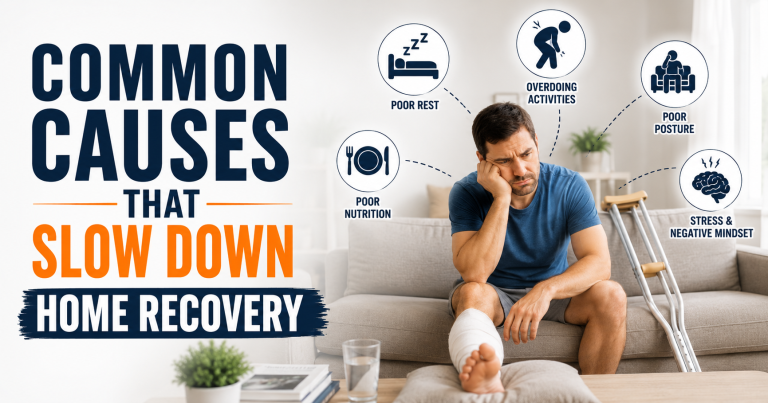
Common Causes That Slow Down Home Recovery
Before learning what to do, it is important to understand what unintentionally slows recovery at home:
- Complete bed rest for long periods
- Fear of movement after discharge
- Lack of structured daily routine
- Poor sitting or lying posture
- Caregiver uncertainty about safe handling
- Emotional distress or lack of motivation
We often see patients in Ahmedabad who improve well in the hospital but become “stuck” at home because movement reduces instead of increasing.
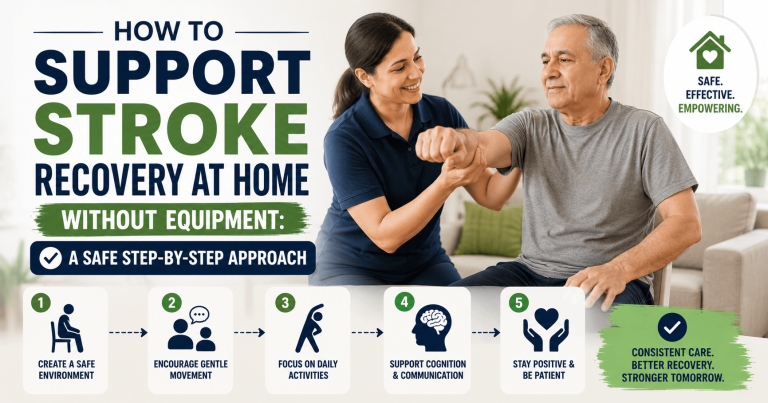
How To Support Stroke Recovery At Home Without Equipment: A Safe Step-by-Step Approach
Home recovery should always focus on three principles:
Safety + Repetition + Function
At Varia Physiotherapy Clinic, we teach families to focus on simple daily movements that do not require machines but still activate brain recovery pathways.
1. Proper Positioning: The Foundation of Recovery
Positioning is often ignored, but it is one of the most powerful tools in early stroke recovery. When a patient lies or sits incorrectly for long periods, muscles tighten and joints become stiff.
What families should do:
- Support the affected arm with a pillow while sitting or lying
- Keep shoulder slightly forward, not hanging backward
- Change position every 2–3 hours
- Keep head, trunk, and hips aligned
- Avoid long periods in one posture
Good positioning reduces pain, prevents contractures, and improves comfort—making later exercises easier.
2. Gentle Assisted Movements (Range of Motion)
This is the most basic and essential exercise group in early recovery. Even without equipment, caregivers can help the patient move affected limbs slowly and safely.
Examples:
- Bend and straighten elbow and knee
- Move wrist and ankle gently in circles
- Lift arm slightly forward with support
- Rotate shoulder carefully within pain-free range
These movements do not build strength immediately—but they prevent stiffness and maintain joint health. Medical evidence from the National Institutes of Health supports early gentle mobilization as a key factor in preventing long-term disability after stroke.
3. Sitting Balance: Rebuilding Core Control
Sitting is often the first functional milestone after a stroke. Many patients can sit but cannot maintain balance without support.
Safe sitting practice:
- atient sits on a firm bed or chair
- Caregiver stays close for safety
- Encourage looking forward, not downward
- Practice shifting weight slightly left and right
- Encourage reaching forward slowly
This retrains core muscles and improves stability needed for standing and walking.
4. Standing Practice: Building Confidence
Once sitting improves, standing becomes the next step.
How to begin:
- Stand near a wall or stable support
- Feet should be flat and shoulder-width apart
- Start with 10–20 seconds
- Gradually increase duration
- Focus on equal weight on both legs
At Varia Physiotherapy Clinic, we emphasize confidence-building more than duration. Fear of falling is often a bigger barrier than weakness itself.
5. Walking Practice at Home
Walking should not be rushed. It must be introduced only when balance improves.
Safe approach:
- Start inside home on flat surface
- Caregiver walks beside patient
- Encourage slow, controlled steps
- Avoid slippery floors or obstacles
- Keep walking distance short initially
Walking is one of the most effective stroke rehabilitation exercises at home, and even 5–10 minutes of controlled practice can support functional recovery.
Real Patient Story from Varia Physiotherapy Clinic (Ahmedabad)
One of our patients, a 62-year-old woman from Ahmedabad, came after a left-sided stroke. She had significant weakness in her right arm and difficulty standing.
Her family initially avoided movement completely because they were afraid she might fall or get injured. As a result, stiffness increased and she developed shoulder pain.
After clinical assessment, we designed a simple home program:
- Assisted limb movements twice daily
- Sitting balance practice for 15 minutes
- Supported standing near a wall
- Short indoor walking sessions
- Caregiver training for safe handling
Within 8 weeks, she improved from full dependency to partial independence in walking with support and could perform basic feeding tasks using her left hand. This case reflects a common reality: recovery improves when movement is guided—not avoided.
Myths vs Facts About Stroke Recovery at Home
Myth 1: Rest is the best recovery method
Fact: Too much rest slows brain re-learning and increases stiffness.
Myth 2: Recovery only happens in the first few months
Fact: Recovery can continue for years with consistent therapy.
Myth 3: Machines are necessary for improvement
Fact: Most early recovery depends on simple guided movement.
Myth 4: If movement is difficult, it should be avoided
Fact: Safe, assisted movement is essential for improvement.
When Families Should Seek Physiotherapy Support
While home care is important, professional evaluation is essential when:
- Progress is not seen for 2–3 weeks
- Increased stiffness or tightness develops
- Shoulder pain or frozen shoulder appears
- Repeated imbalance or falls occur
- Difficulty in speech or swallowing worsens
At Varia Physiotherapy Clinic, we perform detailed assessments including:
- Muscle strength grading
- Balance and gait evaluation
- Tone and spasticity analysis
- Functional independence testing
Based on findings, we create personalized neuro-rehabilitation plans. In some cases, we may refer patients to a neurologist or orthopedic specialist for further medical evaluation when required.
Conclusion
Stroke recovery is not a single treatment—it is a journey that involves the patient, the family, and the rehabilitation team working together.
If you are supporting a loved one at home in Ahmedabad, remember this: you don’t need machines to make progress—you need structure, safety, and consistency.
At Varia Physiotherapy Clinic, we focus on helping families build realistic, safe home routines that complement clinical rehabilitation and improve independence in daily life.
If you are unsure whether your current home care approach is correct, professional guidance can prevent complications and improve outcomes significantly.
You can contact us for a detailed neuro-rehabilitation assessment and personalized home exercise planning.
Book a Professional Assessment
If you’re unsure whether your symptoms need attention, it’s okay to start with a simple consultation. Understanding your condition is the first step toward recovery—no pressure, just guidance.
If you’d like to speak with a physiotherapist or book an assessment at Varia Physiotherapy Clinic, you can reach out here:
 Call: +91 95123 79555
 Email: hello.drhetalvaria@gmail.com
 Website: www.variaphysiotherapyclinic.com
Our team is here to listen, assess, and guide you toward safe and effective recovery.
Stroke Recovery At Home Without Equipment - FAQs