How To Manage Chronic Neck Pain with Physiotherapy
A 42-year-old IT professional came to me after spending ₹38,000 in three months on physiotherapy for back pain.
Machines every day. Same exercises. No reassessment. No diagnosis. Pain unchanged.
What confused him wasn’t just the pain — it was the cost.
One clinic quoted ₹300 per session.
Another pushed a ₹25,000 package.
A third said, “Pain relief guaranteed in 15 days.”
In my experience treating patients across Ahmedabad, most people don’t overpay because physiotherapy is expensive — they overpay because they don’t know what they’re paying for.
Most blogs online talk about “affordable physiotherapy” or “best clinic”.
They don’t answer the real patient question:
“Am I paying for treatment — or just sessions?”
This guide will give you clinical clarity, not sales talk.
REAL PATIENT PROBLEMS
1. Huge price variation with no explanation
₹300–₹2,000 per session — but no one explains why.
Common mistakes people make:
2. Cost quoted before diagnosis
This is a red flag. Treatment cost should depend on:
Condition
Refers to the actual medical or functional problem causing pain or limitation, not just the symptom. Correctly identifying the condition ensures treatment targets the root cause, not temporary relief, which is essential for long-term relief for chronic neck pain in Ahmedabad.
Stage (Acute vs Chronic)
Acute conditions are recent and usually respond faster, while chronic issues develop over time and need a slower, structured approach.
The stage directly affects treatment duration, intensity, and expected recovery.
Complexity
Complexity depends on factors like multiple joints involved, nerve symptoms, past injuries, or other health issues.
Higher complexity often requires more skilled assessment and individualized therapy.
Patient Response
Each patient responds differently to treatment based on healing capacity, compliance, and lifestyle factors.
Progress should be regularly reviewed to adjust or stop therapy when necessary.
3. Machine-based “bulk therapy”
Minimal assessment
When assessment is rushed or skipped, treatment is based on assumptions rather than actual findings.
This often leads to temporary relief without addressing the real cause of pain.
Same Protocol for Everyone
Using identical exercises or machines for all patients ignores individual differences in condition and recovery needs.
What helps one person can delay or worsen recovery in another.
Poor Outcomes for Chronic or Complex Cases
Chronic or complex conditions need detailed evaluation and progressive treatment planning.
Generic or machine-only therapy usually fails to produce lasting improvement in these cases.
4. Long packages with no milestones
No Progress Markers
Without defined progress markers, neither the patient nor the therapist can tell if treatment is actually working.
This leads to continued sessions without clear improvement or direction.
No Reassessment
Regular reassessment is essential to adjust exercises, intensity, or approach based on response.
Skipping reassessment often results in stagnation or worsening of symptoms.
No Stop Criteria
Stop criteria define when therapy should pause, change, or end.
Without them, patients may continue paying for treatment even when further sessions offer little benefit.
5. Chronic patients paying more than they should
Because no one explains that:
Some pain conditions need lifestyle change, medical review, or time, not endless therapy.
Important truth:
Physiotherapy is not always the first or only solution — and cost should reflect that.
STEP-BY-STEP PATIENT ACTION PLAN (COST + CLINICAL LOGIC)
Step 1: Proper Assessment & Diagnosis
What to do:
Before asking “How much per session?”, ask:
What is my diagnosis?
A diagnosis identifies the actual cause of your pain or limitation, not just where it hurts.
It guides the treatment plan and helps avoid unnecessary or ineffective therapy.
Disc stress or degeneration can cause neck pain and stiffness. Poor posture and prolonged loading increase disc pressure.
What structure or movement is causing pain?
This explains whether pain comes from muscles, joints, discs, nerves, or faulty movement patterns.
Understanding this ensures treatment targets the source, not just the symptom.
Muscle imbalance
What structure or movement is causing pain?
This explains whether pain comes from muscles, joints, discs, nerves, or faulty movement patterns.
Understanding this ensures treatment targets the source, not just the symptom.
Compressed or irritated nerves can cause pain, tingling, or weakness. Accurate diagnosis is essential for safe treatment.
Why it matters:
Without diagnosis, cost is meaningless.
Mistakes to avoid:
Limited upper-back movement forces the neck to compensate. Improving thoracic mobility reduces cervical overload.
Mistake to avoid:
- Paying for sessions on day one
- Accepting “muscle tightness” as a diagnosis
Cost insight (Ahmedabad):
- Proper assessment may cost more initially
- But saves thousands later
Step 2: Pain Reduction
What to do:
“Is physiotherapy required right now?”
Hands-on techniques improve joint mobility and reduce stiffness. It helps restore normal movement patterns.
Why it matters:
Targets tight muscles and fascia to relieve tension and pain. Improves flexibility and blood flow.
Rest
Some conditions need reduced activity to allow irritated tissues to settle before therapy begins.
Starting exercises too early can worsen pain and slow healing.
Imaging
X-rays, MRI, or other scans may be required when symptoms suggest structural or nerve involvement.
Imaging helps rule out serious issues and prevents blind or unsafe treatment.
Ortho / Neuro Consult
An orthopedic or neurologist review is necessary when pain involves joints, spine, or nerve symptoms. Early referral prevents missed diagnoses and inappropriate physiotherapy, and once serious causes are ruled out, understanding how physiotherapy reduces long-term neck discomfort helps patients choose the right rehabilitation approach for sustainable recovery.
Ergonomic Correction
Poor posture or work setup can repeatedly trigger pain despite good therapy.
Correcting ergonomics removes the root cause and reduces long-term dependency on treatment.
Mistakes to avoid:
Starting therapy immediately for every pain
Cost reality:
Paying ₹0 now can be smarter than ₹15,000 later.
Step 3: Choosing the Right Type of Physiotherapy
Mistake:
Choosing the cheapest option for a complex problem.
Step 4: First Session Expectations
Detailed History
This involves understanding when the problem started, how it progressed, and what makes it better or worse.
A thorough history helps identify patterns and avoid treating symptoms in isolation.
Physical Assessment
Long, uninterrupted sitting increases muscle fatigue and stiffness. Regular movement breaks reduce strain and pain risk.
Phone usage angle
Holding the phone too low forces the neck to bend forward. Keeping the phone closer to eye level reduces neck stress.
Why it matters:
Most chronic neck pain is posture-driven, not injury-driven.
Mistakes to avoid:
- “Sitting straight” rigidly
- Ignoring breaks
Pro tip:
Best posture is frequent posture change, not one perfect position.
Step 4: Targeted Strengthening & Mobility
What to do:
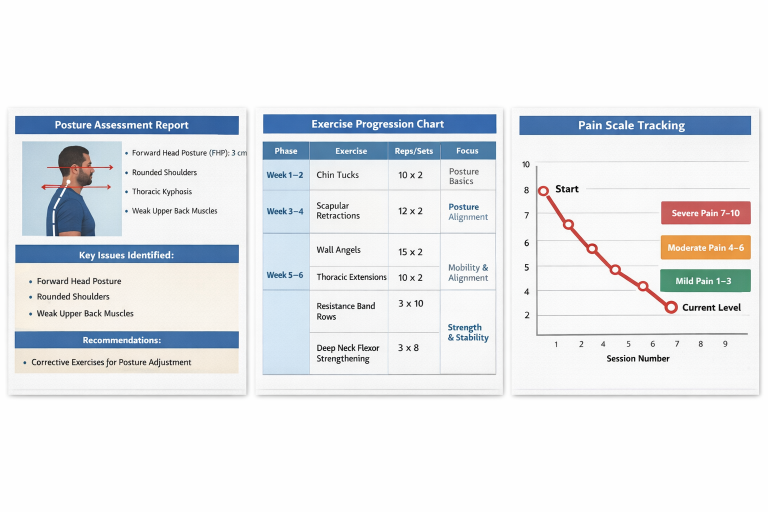
Deep neck flexors
These muscles support neck stability and posture. Weakness here often contributes to chronic neck pain and forward-head posture.
Upper back muscles
They help maintain upright posture and reduce strain on the neck and shoulders. Strong upper back muscles counteract prolonged sitting effects.
Scapular stabilizers
These muscles control shoulder blade movement and alignment. Proper function reduces shoulder and neck overload during daily activities.
Plus mobility work for:
- Thoracic spine
- Shoulder joints
Why it matters:
Weak support muscles overload the neck.
Mistakes to avoid:
- Aggressive stretching
- Heavy resistance too early
Pro tip:
REAL CASE STUDIES
Case Study 1: End-User
- Age: 35
- Condition: 2-year chronic neck pain
- Screen time: ~9 hours/day
Physiotherapy duration: 6 weeks
Sessions: 12
Pain score: Reduced from 8/10 to 1/10
Outcome: Returned to gym, no painkillers needed
Lesson: Posture + strengthening beats passive treatment.
Case Study 2: Investor-Type Patient
- Age: 45
- Condition: Neck pain with arm tingling
- MRI: Mild cervical disc bulge
Physiotherapy duration: 8 weeks
Sessions: 16
Cost avoided: Surgery estimate ₹1.5–2 lakh
Outcome: Full symptom resolution without surgery
Lesson: Early physiotherapy prevents invasive procedures.
Intervention:
TESTIMONIALS
“I thought neck pain was permanent after 10 years of desk work. Physiotherapy changed how I move daily.”
— Amit, Software Engineer, Ahmedabad
“Painkillers stopped working. The structured physio plan finally fixed the root cause.”
— Neha, HR Manager
“I avoided surgery completely through guided physiotherapy.”
— Rohit, Business Owner
VERIFIED FACTS, DATA & CREDIBILITY SIGNALS
WHO recognition of musculoskeletal disorders
Outcome (Real Data):
The World Health Organization identifies musculoskeletal disorders as a leading cause of long-term disability worldwide. This establishes global medical credibility and urgency.
Indian Association of Physiotherapists (IAP) guidelines
IAP guidelines provide standardized, evidence-based physiotherapy practices in India. They signal professional oversight and clinical reliability.
Government health portals on ergonomic safety
Official portals offer verified guidance on posture, workplace ergonomics, and injury prevention. Government-backed information increases public trust.
MRI & X-ray diagnostic protocols
These imaging protocols follow established medical standards to accurately diagnose structural issues. Proper diagnostics reduce misdiagnosis and treatment risk.
PROOFS & SCREENSHOT PLACEMENTS
How To Manage Chronic Neck Pain with Physiotherapy
- FAQs
CONCLUSION
Chronic neck pain is not something you should “live with.”
In my experience, most cases are completely manageable with the right physiotherapy approach, consistency, and habit correction.
The key is not doing more — but doing the right things, in the right order.
If you’re dealing with persistent neck pain, start with a proper assessment and a structured physiotherapy plan — not shortcuts.
 If you want a printable neck-care checklist or a consultation-ready question list, use this guide as your starting point.
References