Best Sleeping Positions During Spinal Cord Recovery Guide
Recovering from a spinal cord injury is not just about movement—it is also about rest.
At Varia Physiotherapy Clinic, one of the most common struggles we hear from patients is:
“Why is sleeping so difficult after a spinal cord injury?”
Many patients expect daytime rehabilitation to be the hardest part. But nighttime often brings its own challenges—pain, stiffness, muscle spasms, numbness, and discomfort from staying in one position too long.
Finding the Best Sleeping Positions During Spinal Cord Recovery can make a significant difference in pain management, pressure relief, spinal alignment, and overall healing.
Good sleep is not a luxury during recovery—it is part of treatment.
According to the World Health Organization, quality sleep supports nervous system healing, tissue repair, and emotional recovery. The National Institutes of Health also highlights the strong connection between sleep quality and physical rehabilitation outcomes.
In this guide, we will explain what actually helps, what to avoid, and how physiotherapy can improve sleep during spinal cord recovery.
Why Sleeping Becomes Difficult After a Spinal Cord Injury
A spinal cord injury affects much more than mobility. It changes how the body manages posture, pressure, sensation, and muscle control.
At our clinic in Ahmedabad, patients commonly report:
- Severe back discomfort while lying down
- Hip pain after staying in one position
- Muscle tightness or spasms at night
- Shoulder pain from side sleeping
- Numbness or tingling in arms or legs
- Difficulty turning in bed independently
These symptoms happen because spinal injuries often disrupt:
1. Muscle Balance
After a spinal cord injury, some muscles become weak while others may tighten. This imbalance makes it harder for your body to maintain proper posture, often causing discomfort and pressure buildup during rest.
2. Nerve Signaling
The spinal cord carries signals between the brain and body. When these signals are disrupted, you may feel increased pain, numbness, or reduced awareness of body position, which can affect comfort while sleeping.
3. Blood Circulation
Staying in one position for long periods can slow blood flow. Poor circulation may lead to stiffness, swelling, and discomfort, making it harder for the body to recover effectively.
4. Pressure Distribution
When the body remains in the same position too long, certain areas like the hips, shoulders, or back take more pressure. Over time, this can increase the risk of skin breakdown or pressure sores, especially during recovery.
This is why choosing the Best Sleeping Positions During Spinal Cord Recovery is essential—not optional.
Best Sleeping Positions During Spinal Cord Recovery
Every spinal injury is different. The best position depends on:
- Injury level
- Pain severity
- Muscle strength
- Spasticity
- Balance control
However, these positions are often safest and most comfortable:
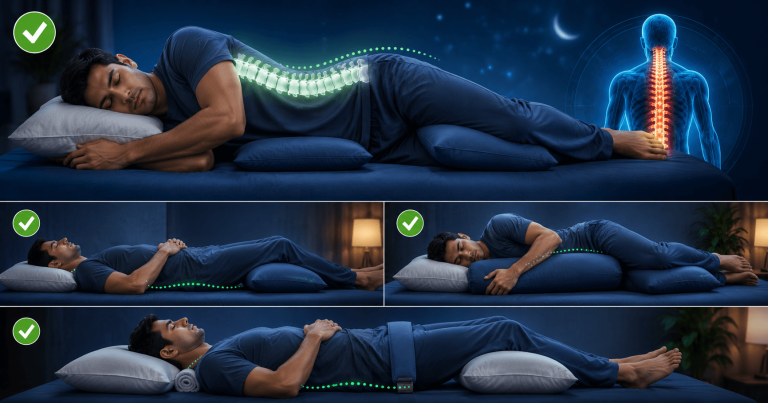
1. Sleeping on Your Back (Most Recommended)
For many spinal cord patients, back sleeping provides the best alignment.
Benefits:
- Keeps spine neutral
- Reduces twisting stress
- Distributes body weight evenly
- Helps prevent muscle imbalance
Tips:
- Place a pillow under knees to reduce lower back pressure
- Use a small neck-support pillow
- Keep hips aligned
At Varia Physiotherapy Clinic, this is often our first recommendation after assessment.
2. Side Sleeping With Pillow Support
This can work well for patients with:
- Lower back pain
- Breathing difficulties
- Mild cervical issues
How to do it:
- Place a pillow between knees
- Keep hips stacked
- Support arms with a pillow
- Avoid curling too tightly
This reduces spinal rotation.
3. Semi-Reclined Position
Useful for patients with:
- Severe pain
- Respiratory weakness
- Post-surgical discomfort
This involves raising the upper body slightly.
It helps reduce:
- Chest pressure
- Acid reflux
- Neck strain
Sleeping Positions to Avoid During Recovery
Not every sleeping posture supports healing.
Avoid:
Sleeping on the Stomach
This can:
- Hyperextend the neck
- Increase spinal compression
- Worsen lower back pain
Twisted Side Positions
Sleeping with your spine twisted or your hips uneven can place extra stress on the muscles, joints, and nerves. Over time, this may increase pain and make recovery more uncomfortable.
Unsupported Sitting Sleep
Some patients try sleeping in a sitting position to avoid pain, especially during the early stages of recovery. While it may feel easier temporarily, poor support can strain the neck, back, and hips if continued for long periods.
Poor sleeping posture can slow down recovery by increasing stiffness, discomfort, and pressure on healing tissues. Proper positioning helps the body rest and heal more effectively.
How Physiotherapy Helps Improve Sleep During Spinal Recovery
Sleep problems often improve when the body functions better. That is where physiotherapy plays a major role. At Varia Physiotherapy Clinic, we use structured assessment to identify why sleeping hurts.
Our process includes:
Step 1: Clinical Assessment
We assess:
- Muscle strength
- Range of motion
- Spasticity levels
- Joint stiffness
- Pressure points
- Bed mobility ability
This helps us understand what sleep posture is safest.
Step 2: Positioning Training
Many patients simply do not know how to position properly.
We teach:
- Safe turning techniques
- Pillow placement
- Pressure relief methods
This reduces pain significantly.
Step 3: Pain Reduction Therapy
Pain can make sleep impossible.
We use:
- Manual therapy
- Joint mobilization
- Soft tissue release
- Heat therapy
- Stretching
These help reduce muscle guarding.
Step 4: Strengthening Weak Areas
Weak core muscles make sleep positions unstable.
We focus on:
- Trunk control
- Hip stability
- Neck support muscles
Step 5: Spasticity Management
Night spasms are common.
Treatment includes:
- Passive stretching
- Position correction
- Neuromuscular facilitation
This can improve sleep quality within weeks.
Real Patient Scenario From Our Clinic
A 46-year-old male patient from Ahmedabad came to us after a traumatic spinal injury caused by a road accident. His biggest complaint was not walking. I was sleeping.
He could not stay in bed for more than two hours because of:
- Lower back pain
- Leg stiffness
- Hip pressure
After evaluation, we found:
- Poor pelvic positioning
- Weak trunk muscles
- Tight hamstrings
Our treatment plan included:
- Proper sleeping posture education
- Night positioning strategies
- Stretching program
- Core stability training
Within 3 weeks:
- Night pain reduced
- Sleep duration improved from 2 hours to 5–6 hours
- Bed turning became easier
This is common. Recovery is often about solving small daily struggles first.
Myths vs Facts About Sleeping During Spinal Recovery
Myth: Hard mattresses are always better
Fact: Medium-firm support is usually better for pressure distribution.
Myth: More pillows mean better comfort
Fact: Incorrect pillow use can worsen alignment.
Myth: Pain during sleep is normal
Fact: Persistent pain often indicates poor positioning.
Myth: Sleep problems will fix themselves
Fact: Without intervention, poor posture can worsen stiffness and pain.
When Should You See a Physiotherapist?
Do not ignore these signs:
- Pain every night while lying down
- Difficulty changing position
- Muscle spasms waking you up
- Tingling or numbness worsening
- Pressure sores developing
- Increased stiffness in morning
At times, physiotherapy alone may not be enough.
Referral to an orthopedic doctor or neurologist may be necessary if:
- Pain is worsening rapidly
- New weakness develops
- Bowel or bladder symptoms change
- Severe nerve compression signs appear
Early intervention matters.
Recovery Takes Time—Be Realistic
Many patients ask:
“How long before sleeping becomes easier?”
The answer depends on:
- Severity of injury
- Age
- Overall health
- Rehabilitation consistency
General expectations:
- Mild cases: 2–6 weeks
- Moderate injuries: 2–4 months
- Severe spinal injuries: 6 months or longer
Recovery is gradual. Small improvements are meaningful. Better sleep often leads to better rehabilitation performance.
That is why focusing on the Best Sleeping Positions During Spinal Cord Recovery can support faster functional progress.
Final Clinical Advice
Healing from spinal cord injury is challenging. But better sleep can make that journey easier.
The Best Sleeping Positions During Spinal Cord Recovery are not the same for everyone. What matters most is proper assessment, body alignment, pressure management, and individualized physiotherapy guidance.
At Varia Physiotherapy Clinic, we help patients across Ahmedabad improve pain, mobility, sleep, and independence through evidence-based rehabilitation.
If sleep has become one of your biggest struggles during recovery, it may be time for a professional physiotherapy assessment. Because healing does not stop when the day ends—it continues while you rest.
Book a Professional Assessment
If you’re unsure whether your symptoms need attention, it’s okay to start with a simple consultation. Understanding your condition is the first step toward recovery—no pressure, just guidance.
If you’d like to speak with a physiotherapist or book an assessment at Varia Physiotherapy Clinic, you can reach out here:
 Call: +91 95123 79555
 Email: hello.drhetalvaria@gmail.com
 Website: www.variaphysiotherapyclinic.com
Our team is here to listen, assess, and guide you toward safe and effective recovery.
Best Sleeping Positions During Spinal Cord Recovery - FAQs