
Coordination Improvement Exercises For Hand, Leg & Full Body Control
Regaining control over your movements is something most people take for granted—until it becomes difficult. At Varia Physiotherapy Clinic in Ahmedabad, we often meet patients who struggle with simple daily activities like holding a cup, walking steadily, or coordinating both hands while dressing. These challenges can be deeply frustrating, especially when they affect independence.
Coordination Improvement Exercises for Hand, Leg & Full Body Control are designed to help restore smooth, accurate, and controlled movements after neurological or musculoskeletal conditions. These exercises are not just about strength—they retrain the brain and body to work together again.
For many patients, improvement is possible, but it requires a structured physiotherapy plan, consistency, and realistic expectations guided by clinical expertise.
Why Coordination Problems Happen
Coordination is controlled by the brain, spinal cord, muscles, and sensory system working together. When any part of this system is disrupted, movement becomes unsteady or poorly timed. According to the World Health Organization (WHO), conditions affecting the nervous system or musculoskeletal health can significantly impact a person’s ability to perform coordinated movements in daily life.
At our clinic in Ahmedabad, we commonly see coordination issues caused by:
1. Stroke or Brain Injury
A stroke or brain injury can temporarily or permanently affect how the brain communicates with the body. Patients often notice weakness on one side, difficulty with balance, and trouble doing precise tasks like writing or buttoning clothes. With early physiotherapy and guided rehabilitation, many patients can regain meaningful functional independence over time.
2. Parkinson’s Disease and Neurological Disorders
In conditions like Parkinson’s disease, changes in brain chemistry affect movement control, leading to stiffness, tremors, and slower coordination. Everyday activities may feel effortful and less smooth than before. Physiotherapy helps by improving mobility, reducing stiffness, and supporting safer, more controlled movement patterns.
3. Spinal Cord Injury or Nerve Damage
Spinal cord or nerve injuries disrupt the communication between the brain and muscles, affecting strength, sensation, and coordination. Patients may experience difficulty walking, gripping objects, or maintaining balance. Structured rehabilitation focuses on maximizing remaining function and improving independence through targeted therapy.
4. Musculoskeletal Injuries or Prolonged Immobilization
After fractures, surgery, or extended bed rest, muscles often become weak and joints stiff, affecting normal movement patterns. Patients may feel unsteady or less coordinated when returning to daily activities. Physiotherapy gradually restores strength, flexibility, and proper movement control for safe recovery.
5. Age-Related Decline
As we age, natural changes in muscles, joints, and reaction time can affect balance and coordination. This may lead to slower movements or difficulty maintaining stability during routine tasks. Regular physiotherapy and balance training can help older adults stay active, confident, and independent in daily life.
Understanding the root cause is essential because Coordination Improvement Exercises for Hand, Leg & Full Body Control must be tailored to each individual’s condition.
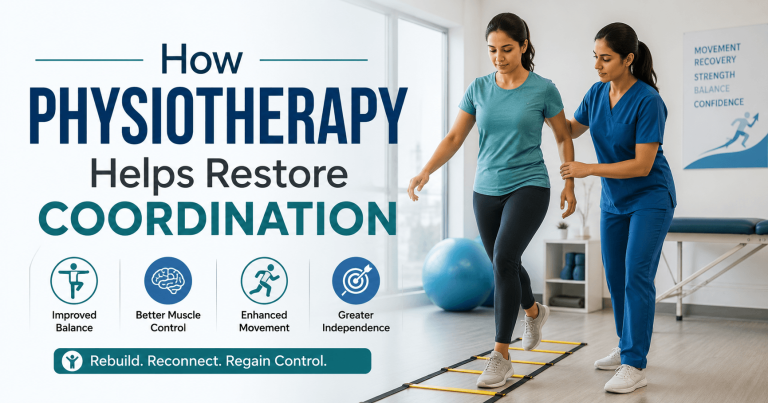
How Physiotherapy Helps Restore Coordination
At Varia Physiotherapy Clinic, treatment is not generic. Every patient undergoes a detailed neurological and musculoskeletal assessment before a plan is created.
We focus on three major principles:
1. Neuroplasticity Training
After a neurological injury, the brain can gradually form new pathways to regain lost functions. Through repetitive and guided movement exercises, physiotherapy helps stimulate these connections, improving the brain’s ability to control movement again in a structured and safe way.
This is why neurological physiotherapy after stroke focuses on repetitive, task-based movement training to rebuild lost neural connections.
2. Task-Oriented Practice
Instead of focusing only on simple exercises, patients are trained to perform real-life activities such as standing, walking, reaching, or holding objects. This approach helps the brain and body work together in a more practical and meaningful way, improving independence in daily life.
3. Sensory Re-education
Many patients lose proper awareness of touch, pressure, or body position after a neurological condition. Sensory re-education exercises help the brain relearn these signals, improving coordination, balance, and overall movement control in everyday activities.
Step-by-Step Physiotherapy Approach
Step 1: Clinical Assessment
We evaluate:
- Muscle strength and tone
- Balance and gait pattern
- Reflexes and coordination level
- Functional independence
This helps us decide which Coordination Improvement Exercises for Hand, Leg & Full Body Control are safe and effective.
Step 2: Basic Activation Exercises
For patients with severe difficulty, we begin with:
- Assisted limb movements
- Gentle range-of-motion exercises
- Breathing and posture control
Step 3: Controlled Coordination Training
Once basic movement improves:
- Finger-to-nose exercises
- Heel-to-shin sliding
- Ball transfer activities
- Mirror therapy for brain retraining
Step 4: Functional Integration
Patients practice real-life activities:
- Walking on uneven surfaces
- Climbing stairs
- Carrying objects while walking
- Dressing and self-care tasks
Step 5: Advanced Balance & Dual-Task Training
To simulate real-world challenges:
- Walking while counting or talking
- Obstacle navigation
- Reaction-based movement drills
Real Patient Scenario from Varia Physiotherapy Clinic
A 58-year-old patient from Ahmedabad visited our clinic after experiencing a mild stroke. He had regained basic strength but struggled with coordination in his right hand and difficulty maintaining balance while walking.
Initially, he could not pick up small objects or walk without support. After a detailed assessment, we designed a rehabilitation plan focusing on Coordination Improvement Exercises for Hand, Leg & Full Body Control.
His therapy included:
- Mirror therapy for hand movement re-education
- Balance training using support bars
- Step-by-step walking practice
- Fine motor skill exercises like object stacking
After 6–8 weeks of consistent physiotherapy, he regained significant independence in daily activities like eating, writing, and walking short distances without support.
Recovery was gradual, and we clearly explained that full recovery depends on brain recovery speed, age, and medical history. In some cases, we also recommend neurological consultation when progressing plateaus.
Myths vs Facts About Coordination Recovery
Myth 1: “Coordination problems cannot improve after stroke”
Fact: Improvement is possible due to neuroplasticity, especially with early physiotherapy intervention.
Myth 2: “Only medication is needed for recovery”
Fact: Medication supports recovery, but physiotherapy is essential for restoring functional movement.
Myth 3: “Rest is better than exercise”
Fact: Excessive rest can worsen stiffness and delay recovery. Guided movement is necessary.
Myth 4: “Recovery should be fast”
Fact: Coordination recovery takes weeks to months depending on severity and patient consistency.
When Should You See a Physiotherapist?
You should consult a physiotherapist if you notice:
- Difficulty in hand-eye coordination
- Unsteady walking or frequent imbalance
- Trouble performing daily tasks like dressing or eating
- Muscle stiffness after injury or stroke
- Slowness in movement or tremors
Early intervention significantly improves outcomes. At Varia Physiotherapy Clinic, we emphasize starting Coordination Improvement Exercises for Hand, Leg & Full Body Control as soon as medically safe.
In some cases, if symptoms suggest progressive neurological disease or severe nerve damage, we may recommend referral to a neurologist or orthopedic specialist for further evaluation.
When Physiotherapy May Not Be Enough
Physiotherapy alone may not be sufficient if:
- There is a complete ligament rupture with instability
- Locking or catching is present in the joint
- Symptoms worsen despite proper rehab
- There is associated fracture or cartilage injury
In such cases, orthopedic evaluation and imaging are necessary.
How Long Does Recovery Take?
Recovery time varies widely:
- Mild coordination issues: 3–6 weeks
- Post-stroke rehabilitation: 3–6 months or longer
- Chronic neurological conditions: ongoing maintenance therapy
Consistency is more important than intensity. Small daily improvements build long-term functional independence.
Conclusion
Regaining coordination is a gradual but achievable process when guided with the right physiotherapy approach. Coordination Improvement Exercises for Hand, Leg & Full Body Control play a vital role in helping patients rebuild balance, movement accuracy, and confidence in daily activities after neurological or musculoskeletal conditions.
At Varia Physiotherapy Clinic, Ahmedabad, we focus on individualized rehabilitation plans based on clinical assessment, patient condition, and realistic recovery goals. While progress varies from person to person, consistent therapy, patience, and proper guidance can significantly improve functional independence over time. In cases where symptoms are complex or progress is limited, collaboration with neurologists or orthopedic specialists ensures comprehensive care.
Most importantly, early intervention and regular practice remain the key factors in achieving the best possible recovery outcomes.
Book a Professional Assessment
If you’re unsure whether your symptoms need attention, it’s okay to start with a simple consultation. Understanding your condition is the first step toward recovery—no pressure, just guidance.
If you’d like to speak with a physiotherapist or book an assessment at Varia Physiotherapy Clinic, you can reach out here:
 Call: +91 95123 79555
 Email: hello.drhetalvaria@gmail.com
 Website: www.variaphysiotherapyclinic.com
Our team is here to listen, assess, and guide you toward safe and effective recovery.
Coordination Improvement Exercises - FAQs
1. Can coordination improve after a stroke?
2. Are Coordination Improvement Exercises for Hand, Leg & Full Body Control painful?
3. How many sessions are needed?
4. Can elderly patients benefit from coordination training?
5. Do I need hospital admission for physiotherapy?
About the Author

Dr. Hetal M Varia
After a rich experience of working in US healthcare as manager and licensed physiotherapist in US for last 11 years, she has returned home with a vision to become pioneer of Vestibular Therapy and specialized Parkinson physiotherapy in Ahmedabad. With her special skills and expertise in vertigo, Parkinson, balance and movement disorders therapy, Dr. Varia is committed to provide US standards of therapy services , compassionate and patient centered care to our people and community. With a vision of the world where everyone walks strong & steady, she intends to empower individuals with vestibular and neurological disorders through specialized care, rehabilitation & innovative therapies to improve mobility, balance & overall quality of life!