
Expert Motion Sensitivity Physiotherapy Exercises For Dizziness Relief
Motion sensitivity is a common but often misunderstood problem seen in vestibular and neuro-rehabilitation clinics. Patients usually describe it as dizziness, imbalance, or discomfort during head or body movement, especially while walking, turning, or changing posture.
As a physiotherapist, I see this condition frequently in patients recovering from vestibular disorders, post-viral inner ear issues, concussion, or neurological conditions. The good news is that with the right vestibular rehabilitation, balance training, and structured therapy, most patients improve significantly over time.
However, recovery is not instant—and the wrong exercises or avoidance habits can actually delay healing.
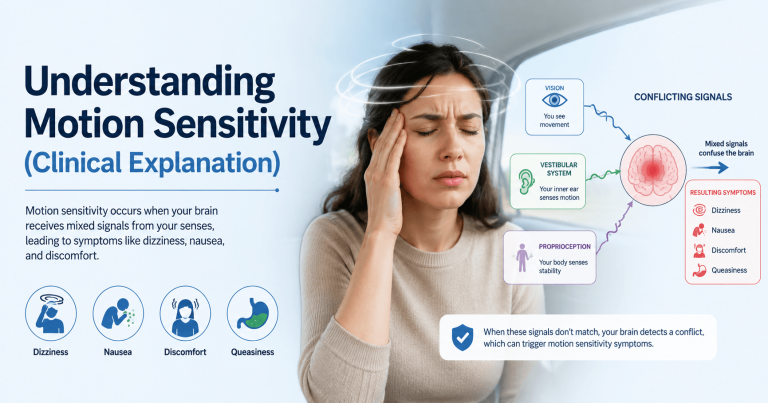
Understanding Motion Sensitivity (Clinical Explanation)
Motion sensitivity is not a disease itself. It is a functional problem of the vestibular system, where the brain struggles to correctly process signals related to movement, balance, and spatial orientation.
The key systems involved include:
- Vestibular system (inner ear balance organ)
- Visual system (eyes and gaze control)
- Proprioception (body position awareness from muscles and joints)
When these systems are not working in coordination, patients experience:
- Dizziness
- Vertigo sensations
- Instability during movement
- Difficulty with head turns
- Delayed reflex responses
- Fatigue and mental discomfort
This is why coordination, equilibrium, and sensory integration training becomes essential in rehabilitation.
Common Causes Seen in Clinical Practice
1. Vestibular Dysfunction
Inner ear problems can interfere with the brain’s ability to process balance and movement signals properly. This often leads to dizziness, imbalance, vertigo, and difficulty with coordination during daily activities. Symptoms may become worse with sudden head movements or crowded visual environments. Vestibular rehabilitation exercises help retrain the balance system and improve stability over time.
2. Post-Viral Imbalance
After viral infections, the vestibular system may become temporarily disrupted, causing unsteadiness, motion sensitivity, and poor balance control. Symptoms may continue even after the infection has resolved. Many patients also experience fatigue and reduced confidence while walking. Early physiotherapy intervention can support faster adaptation and recovery.
3. Cervical (Neck) Dysfunction
Neck stiffness, poor posture, or cervical joint issues can affect head positioning and body awareness. This may contribute to dizziness, reduced mobility, and difficulty maintaining stable movement. Prolonged desk work and muscle tension often worsen these symptoms. Neck mobility, posture correction, and motion sensitivity treatment exercises can improve proprioception, coordination, and overall balance control.
4. Neurological Conditions
Conditions such as stroke or Parkinson’s disease can impact motor control, reflexes, and coordination. These neurological changes often reduce balance confidence and increase the risk of falls. Patients may struggle with gait stability and movement accuracy during daily activities. Structured neurological rehabilitation helps improve functional mobility and independence.
5. Migraine-Associated Dizziness
Migraines can disturb sensory processing within the brain, leading to dizziness, motion intolerance, and visual sensitivity. Symptoms may occur even without a severe headache. Bright lights, screen exposure, and rapid movements can trigger discomfort in some individuals. Balance retraining and lifestyle adjustments may help reduce symptom frequency.
6. Anxiety-Related Sensory Overload
Stress and anxiety can heighten sensory responses and worsen feelings of dizziness or motion sensitivity. This may also lead to fatigue, poor concentration, and reduced confidence in movement. Many individuals become overly aware of body sensations, which increases discomfort further. Relaxation strategies and gradual exposure exercises can help restore confidence and control.
Key Symptoms Patients Commonly Experience
Patients with motion sensitivity often report:
- Dizziness during movement
- Vertigo-like spinning sensation
- Feeling unstable while walking
- Difficulty turning the head
- Blurred vision during motion
- Fatigue after minimal activity
- Sensation of floating or swaying
- Fear of movement due to symptom worsening
Over time, patients may reduce activity levels, which leads to worsening mobility, posture, and functional strength. This is a critical issue we address in rehabilitation.
Clinical Assessment Approach
Before starting any exercise program, a proper evaluation is necessary. In physiotherapy, we assess:
- Balance and stability control
- Gaze stability and eye-head coordination
- Posture and spinal alignment
- Reflex response to movement
- Vestibular system function
- Coordination and motor control
- Sensory integration ability
This helps us understand whether the problem is primarily vestibular, neurological, cervical, or functional.
Without proper assessment, random exercises may worsen symptoms instead of improving them.
Motion Sensitivity Physiotherapy Exercises (Step-by-Step)
Phase 1: Early Adaptation and Control Training
This phase focuses on gentle stimulation of the nervous system without overwhelming it.
1. Gaze Stabilization Exercises
Gaze stabilization exercises help improve coordination between eye movements and head movements. These exercises train the vestibular system to maintain clear vision during motion and reduce dizziness symptoms. Regular practice can improve visual focus, balance control, and motion tolerance during daily activities.
- Sit upright
- Focus on a fixed point on the wall
- Slowly move the head left and right while keeping eyes fixed
- Repeat up and down movement
Purpose: Improves eye-head coordination and vestibular control
2. Slow Head Movement Training
Slow head movement training helps the brain gradually adapt to movement without triggering excessive dizziness. Controlled movements improve vestibular adaptation, coordination, and sensory processing. This exercise also helps patients build confidence while reducing motion sensitivity over time.
- Turn head slowly side to side
- Pause between movements
- Maintain steady breathing
Purpose: Enhances adaptation and motion tolerance
3. Postural Alignment Training
Postural alignment training focuses on maintaining proper spinal posture and body positioning during sitting and standing activities. Correct posture improves balance, muscle activation, and movement efficiency. It also reduces unnecessary strain on the neck and improves overall stability control.
- Sit or stand with correct spinal alignment
- Engage core muscles gently
- Avoid slouching
Purpose: Improves posture stability and alignment control
Phase 2: Balance and Coordination Training
Once initial dizziness reduces, we progress to more dynamic training.
1. Static Balance Exercises
Static balance exercises help strengthen equilibrium and body control while standing still. These exercises improve stability, coordination, and confidence in maintaining upright posture. Progressing from basic standing positions to single-leg balance enhances neuromuscular control and fall prevention.
- Stand with feet together
- Progress to single-leg standing
- Maintain focus on a fixed point
Improves equilibrium and stability control
2. Weight Shift Training
Weight shift training improves the body’s ability to transfer weight smoothly in different directions. These exercises enhance coordination, posture control, and movement awareness during functional activities. Controlled shifting also helps improve balance reactions and stability during walking.
- Shift body weight left to right
- Then forward and backward
- Maintain controlled breathing
Improves coordination and movement control
3. Walking with Head Movement
Walking with head movement challenges the vestibular system to maintain balance while the body is in motion. This exercise improves visual stability, coordination, and mobility during everyday activities. It also helps patients become more comfortable with movement-related dizziness triggers.
- Walk slowly
- Turn head gently while walking
- Maintain visual focus
Improves vestibular integration and mobility
Phase 3: Functional Movement Training
This phase prepares patients for real-life activity.
1. Stair Climbing Practice
Improves strength, endurance, and balance control
2. Direction Change Walking
- Walk and change direction gradually
- Avoid sudden movements initially
Improves reflex response and orientation control
3. Dual-Task Training
- Walking while counting or speaking
- Improves neurological coordination and sensory integration
What Actually Works in Clinical Recovery
Based on evidence-based physiotherapy practice:
- Gradual exposure to movement (habituation)
- Vestibular rehabilitation exercises
- Gaze stabilization training
- Balance and proprioception training
- Consistent repetition for neuroplasticity
The brain adapts through repeated controlled exposure, not avoidance.
What Patients Should Avoid
- Complete rest for long durations
- Avoiding all head movement
- Random internet-based exercises without diagnosis
- Overtraining during severe dizziness
- Ignoring neck posture and core stability
Clinical Case Example
A 45-year-old patient came with persistent motion sensitivity after a viral illness. He avoided movement for nearly one month due to fear of dizziness.
On assessment:
- Reduced vestibular adaptation
- Poor gaze stability
- Weak postural control
- High movement fear response
Treatment plan:
- Gaze stabilization exercises
- Gradual motion exposure
- Balance retraining
- Core strengthening
- Functional walking training
Outcome:
Noticeable improvement within 3 weeks. Full functional recovery achieved in approximately 6–8 weeks.
This reflects typical vestibular rehabilitation recovery patterns.
When to Seek Medical Referral
Physiotherapy alone is not enough when:
- Sudden neurological weakness occurs
- Severe headache with dizziness persists
- Speech or vision disturbances appear
- Progressive coordination loss is seen
- Symptoms worsen despite therapy
These require neurological evaluation.
Home Care Mistakes That Delay Recovery
Many patients unknowingly slow down healing by:
- Excessive bed rest
- Poor posture during daily work
- Irregular exercise routine
- Anxiety-driven movement avoidance
- Overuse of mobile screens in poor posture
Correcting these habits significantly improves recovery, adaptation, and healing.
Expected Recovery Timeline
Recovery depends on severity and consistency:
- Mild motion sensitivity: 2–4 weeks
- Moderate vestibular dysfunction: 4–8 weeks
- Neurological conditions: longer structured rehabilitation
The key factor is not severity alone, but neuroplasticity response, consistency, and training quality.
Conclusion:
Motion sensitivity is a treatable functional condition, not a lifelong limitation. The goal of physiotherapy is to retrain the brain through controlled movement exposure, improving:
- Vestibular system efficiency
- Balance and stability
- Coordination and reflex control
- Postural alignment
- Sensory integration
With the right rehabilitation approach, patients regain confidence in movement and return to normal daily activities.
The most important principle is simple: do not avoid movement—retrain it safely and progressively.