
Effective Balance Confidence Therapy Exercises For Daily Stability
Feeling unsteady while walking, climbing stairs, or turning quickly can affect much more than physical movement. Many adults begin avoiding daily activities because they fear losing balance or falling. Over time, this fear reduces confidence, limits independence, and affects overall quality of life.
At Varia Physiotherapy Clinic, we regularly meet adults between 30 and 65 years old who struggle with dizziness, instability, weakness, or reduced movement confidence caused by musculoskeletal injuries, neurological conditions, poor posture, or age-related balance decline. Some patients feel unsafe while walking outdoors, while others hesitate to move around their own homes without support.
The good news is that balance problems can often improve significantly with structured physiotherapy. Through effective balance confidence therapy exercises for daily stability, patients can rebuild coordination, improve posture, restore safe mobility, and regain independence in everyday life.
These exercises are not simply generic workouts. They are carefully designed programs focusing on postural stability, core balance, equilibrium training, dynamic balance, static balance, and functional confidence. When practiced consistently under professional guidance, they help retrain the body and brain to work together more efficiently.
This article explains the common causes of instability, how physiotherapy improves movement confidence, which exercises are commonly recommended, and when professional assessment becomes important.
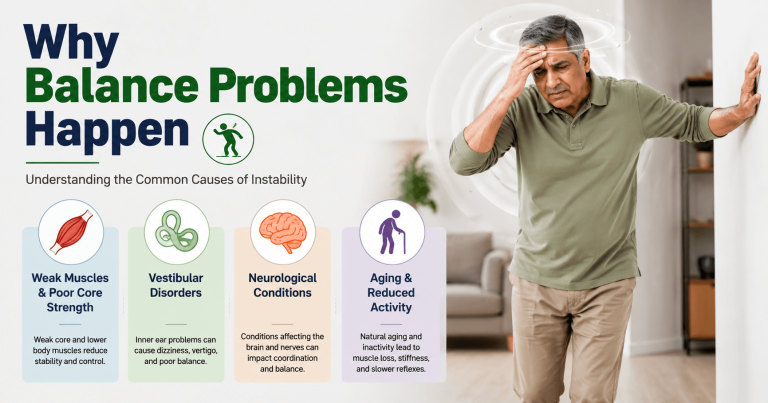
Why Balance Problems Happen
Balance is a complex function involving muscles, joints, nerves, vision, and the inner ear. Even minor dysfunction in one area can affect overall stability.
1. Weak Core and Lower Body Muscles
The body relies heavily on the core, hips, knees, and ankles for center of gravity control. Weakness in these areas often leads to poor posture, slow reactions, and difficulty maintaining upright alignment. In many cases, balance confidence rehabilitation exercises help strengthen these muscle groups while improving coordination and overall stability.
Patients with weak muscles frequently struggle with:
- Standing for long periods
- Walking on uneven surfaces
- Turning quickly
- Getting up from chairs
- Climbing stairs
In such cases, core strengthening, lower body strengthening, and muscle stabilization exercises become essential parts of rehabilitation.
2. Vestibular Disorders
The vestibular system inside the inner ear helps the brain understand movement and body position. Conditions affecting this system may cause:
- Dizziness
- Vertigo
- Walking instability
- Motion sensitivity
- Fear of falling
Patients with vestibular dysfunction often benefit from:
- Vestibular therapy
- Equilibrium training
- Controlled movement exercises
- Proprioception training
- Walking stability exercises
At Varia Physiotherapy Clinic, vestibular rehabilitation programs are customized according to symptom severity and movement triggers.
3. Neurological Conditions
Stroke, Parkinson’s disease, nerve injuries, multiple sclerosis, and other neurological conditions may interfere with:
- Coordination
- Reaction speed
- Gait control
- Spatial awareness
- Postural reflexes
These patients often require:
- Neuro-rehab exercises
- Motor control exercises
- Coordination exercises
- Reaction time drills
- Functional stability drills
Physiotherapy helps retrain movement patterns while gradually improving daily functional independence.
4. Aging and Reduced Activity
As people age, muscle strength, joint flexibility, and reflexes naturally decline. Reduced physical activity further weakens the body’s balance systems.
Common age-related concerns include:
- Slow walking speed
- Difficulty recovering after losing balance
- Reduced confidence in motion
- Poor gait confidence
- Increased fall risk
Structured physiotherapy programs focusing on daily balance practice and mobility enhancement exercises help older adults stay active and independent.
How Physiotherapy Improves Daily Stability
Balance is a complex function involving muscles, joints, nerves, vision, and the inner ear. Even minor dysfunction in one area can affect overall stability.
1. Weak Core and Lower Body Muscles
The body relies heavily on the core, hips, knees, and ankles for center of gravity control. Weakness in these areas often leads to poor posture, slow reactions, and difficulty maintaining upright alignment.
Patients with weak muscles frequently struggle with:
- Standing for long periods
- Walking on uneven surfaces
- Turning quickly
- Getting up from chairs
- Climbing stairs
In such cases, core strengthening, lower body strengthening, and muscle stabilization exercises become essential parts of rehabilitation.
2. Vestibular Disorders
The vestibular system inside the inner ear helps the brain understand movement and body position. Conditions affecting this system may cause:
- Dizziness
- Vertigo
- Walking instability
- Motion sensitivity
- Fear of falling
Patients with vestibular dysfunction often benefit from:
- Vestibular therapy
- Equilibrium training
- Controlled movement exercises
- Proprioception training
- Walking stability exercises
At Varia Physiotherapy Clinic, vestibular rehabilitation programs are customized according to symptom severity and movement triggers.
3. Neurological Conditions
Stroke, Parkinson’s disease, nerve injuries, multiple sclerosis, and other neurological conditions may interfere with:
- Coordination
- Reaction speed
- Gait control
- Spatial awareness
- Postural reflexes
These patients often require:
- Neuro-rehab exercises
- Motor control exercises
- Coordination exercises
- Reaction time drills
- Functional stability drills
Physiotherapy helps retrain movement patterns while gradually improving daily functional independence.
4. Aging and Reduced Activity
As people age, muscle strength, joint flexibility, and reflexes naturally decline. Reduced physical activity further weakens the body’s balance systems.
Common age-related concerns include:
- Slow walking speed
- Difficulty recovering after losing balance
- Reduced confidence in motion
- Poor gait confidence
- Increased fall risk
Structured physiotherapy programs focusing on daily balance practice and mobility enhancement exercises help older adults stay active and independent.
How Physiotherapy Improves Daily Stability
Physiotherapy focuses on improving both physical stability and psychological confidence. Many people stop moving naturally after a fall or near-fall because they fear another accident. This creates stiffness, weakness, and worsening instability.
Therapy gradually rebuilds movement confidence through controlled progression.
Initial Physiotherapy Assessment
Before beginning exercises, physiotherapists evaluate:
- Standing posture
- Walking pattern
- Joint mobility
- Muscle strength
- Balance reactions
- Coordination
- Vestibular symptoms
- Fall history
Clinical assessments help determine whether symptoms are primarily musculoskeletal, neurological, or vestibular.
In some situations, referral to an orthopedic specialist or neurologist may be recommended for further investigation.
Effective Balance Confidence Therapy Exercises For Daily Stability
1. Postural Stability Exercises
Poor posture shifts body weight inefficiently and reduces stability.
Common exercises include:
- Wall posture correction
- Pelvic alignment practice
- Shoulder alignment exercises
- Seated posture retraining
These body alignment exercises improve spinal positioning and enhance postural stability during standing and walking.
Benefits include:
- Better weight distribution
- Reduced fatigue
- Improved standing endurance
- Greater everyday movement assurance
2. Core Balance Training
The core muscles stabilize the trunk during movement. Weak core muscles often contribute to imbalance.
Core balance exercises may include:
- Pelvic tilts
- Bridging exercises
- Seated stability drills
- Modified planks
- Controlled trunk rotations
These exercises strengthen deep stabilizing muscles and improve core balance during daily activities.
Patients often notice:
- Better sitting balance
- Easier transfers
- Improved walking stability
- Greater self-assured movement
3. Dynamic Balance Exercises
Dynamic balance refers to maintaining control while moving.
Exercises may include:
- Side stepping
- Tandem walking
- Direction-change walking
- Obstacle navigation
- Multi-direction stepping
These dynamic balance exercises challenge coordination and improve the body’s ability to react safely during movement.
They are especially useful for patients struggling with:
- Uneven surfaces
- Busy environments
- Quick turns
- Outdoor walking
4. Static Balance Exercises
Static balance focuses on maintaining stability while stationary.
Examples include:
- Single-leg standing
- Heel-to-toe standing
- Narrow stance balance
- Eyes-closed standing practice
These static balance drills improve muscle activation and postural awareness.
Static training is often the foundation before progressing to advanced movement activities.
5. Weight-Shifting Exercises
Many patients lose confidence shifting body weight from one side to another.
Weight-shifting exercises help patients:
- Improve coordination
- Increase walking efficiency
- Enhance balance reactions
- Improve gait confidence
These drills are especially useful after injury, surgery, or neurological conditions.
Healing capacity changes with age and overall health. Conditions like diabetes, poor fitness, or smoking can slow tissue repair and require a more cautious rehabilitation plan.
6. Proprioception Training
Proprioception is the body’s ability to sense position and movement.
When proprioception declines, patients may feel disconnected from their movements.
Proprioception training may include:
- Foam surface balance
- Closed-eye drills
- Joint position exercises
- Controlled stepping tasks
Improved proprioception leads to:
- Better joint stability training
- Faster reaction speed
- Enhanced movement confidence
7. Coordination and Motor Control Exercises
Neurological and vestibular patients often struggle with coordination.
Coordination exercises may involve:
- Hand-leg movement synchronization
- Directional stepping
- Multi-task walking
- Ball coordination activities
Motor control exercises focus on:
- Controlled movement quality
- Muscle timing
- Precision during walking
These exercises gradually restore smoother, safer movement patterns.
8. Vestibular Rehabilitation Exercises
Patients with dizziness or vertigo require specialized therapy.
Vestibular therapy may include:
- Head movement training
- Gaze stabilization
- Visual tracking
- Motion desensitization
- Controlled positional changes
These exercises help the brain adapt to abnormal vestibular signals.
Many patients initially feel uncomfortable during vestibular rehab, but symptoms usually improve progressively with consistent practice.
Real Patient Scenario
A 54-year-old office worker from Ahmedabad visited Varia Physiotherapy Clinic after experiencing instability while walking and frequent near-falls during crowded travel. She had gradually developed a severe fear of falling and stopped participating in outdoor activities.
Assessment revealed:
- Poor postural control
- Reduced core strength
- Vestibular sensitivity
- Weak lower limb coordination
Her rehabilitation program included:
- Functional exercise routines
- Standing balance training
- Weight-shifting exercises
- Controlled movement exercises
- Daily movement therapy
- Mobility enhancement exercises
Initially, she struggled with confidence in motion and required support during balance drills. Within six weeks, she reported significant improvement in walking stability and reduced anxiety during daily activities.
After three months of structured therapy and consistent home practice, she resumed independent shopping, social outings, and stair climbing comfortably.
Myths vs Facts About Balance Therapy
Myth: Balance problems only affect elderly people.
Fact:
Vestibular disorders, injuries, neurological conditions, and sedentary lifestyles can affect adults of all ages.
Myth: Rest is the best solution for dizziness.
Fact:
Excessive inactivity often worsens instability. Properly guided movement improves recovery.
Myth: Falls happen suddenly without warning.
Fact:
Many patients experience gradual warning signs such as instability, slow walking, reduced confidence, or difficulty turning.
Myth: Balance exercises are unsafe.
Fact:
When supervised appropriately, physiotherapy exercises are designed to improve safe mobility progressively.
When To See A Physiotherapist
You should seek professional assessment if you experience:
- Frequent imbalance
- Dizziness while walking
- Difficulty climbing stairs
- Fear of falling
- Repeated near-falls
- Reduced walking confidence
- Post-injury instability
- Vestibular symptoms
- Neurological movement problems
Early intervention often prevents worsening mobility limitations.
Home Tips For Better Daily Stability
Along with therapy, these strategies help improve safety:
- Wear supportive footwear
- Avoid slippery surfaces
- Improve home lighting
- Stay physically active
- Practice prescribed exercises consistently
- Use handrails where needed
- Avoid sudden head movements if dizzy
Conclusion:
Living with instability can affect every aspect of daily life, from walking and working to social participation and independence. However, balance problems are often manageable with the right rehabilitation approach.
Through effective balance confidence therapy exercises for daily stability, patients can improve postural stability, strengthen muscles, restore coordination, enhance gait confidence, and regain safe mobility.
At Varia Physiotherapy Clinic, our physiotherapists create personalized rehabilitation programs combining balance therapy, vestibular therapy, functional stability drills, coordination exercises, and daily movement therapy to help patients move confidently again.
If balance problems, dizziness, or fear of falling are limiting your daily life, professional physiotherapy assessment can help identify the root cause and guide a safe recovery journey.
Book a Professional Assessment
If you’re unsure whether your symptoms need attention, it’s okay to start with a simple consultation. Understanding your condition is the first step toward recovery—no pressure, just guidance.
If you’d like to speak with a physiotherapist or book an assessment at Varia Physiotherapy Clinic, you can reach out here:
 Call: +91 95123 79555
 Email: hello.drhetalvaria@gmail.com
 Website: www.variaphysiotherapyclinic.com
Our team is here to listen, assess, and guide you toward safe and effective recovery.