
Inner Ear Problems Causing Vertigo Treatment In Ahmedabad
Vertigo isn’t just “feeling dizzy.” For many adults in Ahmedabad, it can feel like the room is spinning, balance is unreliable, and everyday tasks suddenly become difficult. If you’ve experienced sudden dizziness while getting out of bed, turning your head, or even walking, you’re not alone.
At Varia Physiotherapy Clinic, we regularly meet patients between 30–65 years who come in worried, confused, and often misdiagnosed. This guide on Inner Ear Problems Causing Vertigo Treatment In Ahmedabad is designed to help you understand what’s happening in your body—and what you can realistically do about it.

Understanding Vertigo: What’s Really Happening?
Vertigo is commonly linked to issues in the inner ear, which plays a crucial role in maintaining balance. When this system is disrupted, your brain receives incorrect signals about your body’s position.
According to the World Health Organization, balance disorders are a significant contributor to fall risk and reduced quality of life, especially in adults over 40.
Common Inner Ear Causes of Vertigo
1. Benign Paroxysmal Positional Vertigo (BPPV)
A common cause of vertigo where tiny calcium crystals in the inner ear become displaced. These crystals disrupt normal balance signals, leading to brief spinning sensations with head movements. Episodes are usually short but can feel intense. It is highly treatable with specific repositioning maneuvers.
2. Vestibular Neuritis
This condition involves inflammation of the vestibular nerve, often triggered by a viral infection. It causes sudden, severe vertigo without hearing loss. Patients may experience nausea, imbalance, and difficulty walking. Symptoms gradually improve as the brain adapts.
3. Labyrinthitis
Labyrinthitis is an inner ear infection that affects both balance and hearing. It leads to vertigo along with hearing loss and sometimes ringing in the ears. Symptoms can be more severe than vestibular neuritis. Early treatment helps reduce complications and recovery time.
4. Meniere’s Disease
A chronic inner ear disorder characterized by episodes of vertigo, hearing loss, tinnitus, and a feeling of fullness in the ear. Attacks can last from minutes to hours and may recur unpredictably. It is linked to fluid imbalance in the inner ear. Long-term management focuses on controlling symptoms and preventing flare-ups.

Why Vertigo Should Not Be Ignored
Many patients assume dizziness will “just go away.” But untreated vertigo can lead to long-term complications and reduced independence.
Research published by the National Institutes of Health highlights that vestibular disorders are often underdiagnosed, yet highly responsive to targeted rehabilitation therapies like vestibular physiotherapy.
- Increase fall risk
- Reduce confidence in mobility
- Affect work productivity
- Cause anxiety and fear of movement
At Varia Physiotherapy Clinic, we often see patients months after symptoms begin—when early intervention could have made recovery faster.
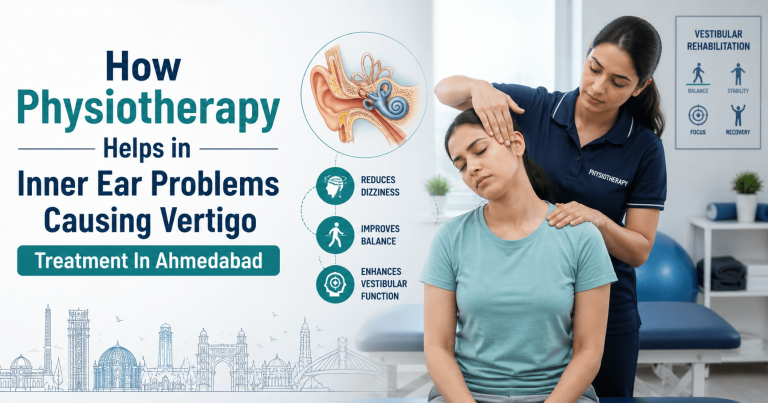
How Physiotherapy Helps in Inner Ear Problems Causing Vertigo Treatment In Ahmedabad
Physiotherapy is one of the most effective, non-invasive treatments for vertigo—especially when caused by inner ear dysfunction.
Step 1: Detailed Clinical Assessment
The process begins with a structured evaluation to understand the root cause of your dizziness. This includes reviewing your medical history, analyzing symptom patterns, and assessing balance and walking. Special positional tests help pinpoint conditions like BPPV. The goal is to identify whether the issue is vestibular, neurological, or musculoskeletal.
We begin with a structured evaluation:
- Medical history review
- Symptom pattern analysis (when dizziness occurs)
- Balance and gait assessment
- Positional tests (like Dix-Hallpike test for BPPV)
This helps us identify whether your vertigo is vestibular (inner ear), neurological, or musculoskeletal.
Step 2: Targeted Treatment Approach
Treatment is personalized based on the diagnosis to ensure effective recovery. It may include repositioning maneuvers for BPPV, vestibular rehabilitation exercises, or neck-focused therapy. These techniques help restore balance, reduce dizziness, and improve daily function. Each plan is tailored to your specific symptoms and condition.
1. Canalith Repositioning Maneuvers (for BPPV)
These are specific head and body movements designed to reposition displaced calcium crystals in the inner ear. Techniques like the Epley maneuver help restore normal balance signals. The procedure is quick, non-invasive, and often provides immediate relief. It is one of the most effective treatments for BPPV.
2. Vestibular Rehabilitation Therapy (VRT)
VRT is a customized exercise program aimed at retraining the brain to adapt to balance disturbances. It helps reduce dizziness, improve stability, and restore confidence in movement. The therapy is tailored based on individual symptoms and progress. Over time, it enhances overall balance control.
Includes:
- Gaze stabilization exercises
- Balance retraining
- Habituation exercises
3. Postural & Neck Treatment
This approach focuses on correcting neck-related issues that may contribute to dizziness, often seen in cervicogenic vertigo. Treatment includes improving posture, reducing muscle stiffness, and restoring proper neck mobility. It helps relieve strain on the cervical spine and enhances balance. Addressing these factors can significantly reduce dizziness and prevent recurrence.
Sometimes vertigo is linked to cervical spine issues (cervicogenic dizziness). We address:
- Neck stiffness
- Poor posture
- Muscle imbalances
Step 3: Home Exercise Program
Recovery continues beyond the clinic with a guided home exercise routine. Patients are advised on daily exercises, safe movements, and lifestyle adjustments. This helps reinforce treatment outcomes and prevent recurrence. Consistency plays a crucial role in achieving long-term relief and stability.
Recovery doesn’t end at the clinic. Patients are guided with:
- Daily exercises
- Movement precautions
- Lifestyle adjustments
Consistency is key for long-term improvement.
Real Patient Scenario from Varia Physiotherapy Clinic
A 52-year-old working professional from Ahmedabad visited us with complaints of sudden spinning sensations when lying down or turning in bed.
- Duration: 3 weeks
- Previous treatment: General medication with no relief
- Diagnosis: BPPV
After just 2 sessions of repositioning maneuvers, symptoms reduced significantly. Within a week, the patient returned to normal daily activities.
Another case involved a 45-year-old woman experiencing dizziness along with neck pain due to prolonged desk work. Her treatment included both vestibular rehab and cervical physiotherapy. Recovery took about 3–4 weeks, showing how combined factors can influence vertigo.
Myths vs Facts About Vertigo
Myth 1: Vertigo is always a brain problem
Fact: Most cases are related to inner ear dysfunction, not the brain.
Myth 2: Bed rest is the best treatment
Fact: Controlled movement and exercises are essential for recovery.
Myth 3: Medicines alone can cure vertigo
Fact: Medication may reduce symptoms, but physiotherapy treats the root cause.
Myth 4: Vertigo will go away on its own
Fact: Some cases may resolve, but many persist or worsen without treatment.
When Should You See a Physiotherapist?
You should seek help if you experience:
- Repeated episodes of dizziness
- Spinning sensation when changing position
- Balance issues while walking
- Dizziness with neck pain
- Fear of falling
When Referral Is Needed
At Varia Physiotherapy Clinic, patient safety comes first. We may refer you to a specialist if:
- Symptoms suggest neurological involvement
- There is sudden hearing loss
- Severe headaches or vision issues are present
- No improvement after initial therapy
We collaborate with orthopedic doctors and neurologists when necessary.
Recovery Timeline: What to Expect
Recovery varies depending on the condition:
- BPPV: 1–3 sessions (quick relief)
- Vestibular neuritis: 3–6 weeks
- Cervicogenic dizziness: 2–4 weeks
- Chronic vertigo cases: 6–8 weeks with guided rehab
There is no “one-size-fits-all” timeline. Your progress depends on consistency and underlying cause.
Conclusion:
Vertigo caused by inner ear problems can disrupt even the simplest daily activities—but with the right diagnosis and treatment, it is highly manageable. At Varia Physiotherapy Clinic, the focus is not just on reducing symptoms, but on identifying the root cause and restoring your balance through evidence-based physiotherapy.
If you’re experiencing recurring dizziness, spinning sensations, or balance issues, early intervention can make a significant difference in your recovery timeline. Through targeted techniques like vestibular rehabilitation, repositioning maneuvers, and postural correction, many patients see meaningful improvement within weeks.
For anyone searching for Inner Ear Problems Causing Vertigo Treatment In Ahmedabad, the key is not to ignore symptoms or rely solely on medication. A structured physiotherapy approach can help you regain stability, confidence, and quality of life—safely and effectively.
Ethical Call-to-Action
If you’re unsure whether your symptoms need attention, it’s okay to start with a simple consultation. Understanding your condition is the first step toward recovery—no pressure, just guidance.
If you’d like to speak with a physiotherapist or book an assessment at Varia Physiotherapy Clinic, you can reach out here:
 Call: +91 95123 79555
 Email: hello.drhetalvaria@gmail.com
 Website: www.variaphysiotherapyclinic.com
Our team is here to listen, assess, and guide you toward safe and effective recovery.
Inner Ear Problems Causing Vertigo Treatment In Ahmedabad: FAQs
Not always, but it increases fall risk. Proper diagnosis is important.
In many cases like BPPV, yes. In others, it helps manage and reduce symptoms effectively.
Not always. Clinical assessment often identifies the cause. Imaging is recommended only when needed.
Yes. Cervical spine issues can lead to cervicogenic dizziness.
Some patients feel relief in 1–2 sessions; others may take weeks depending on severity.
About the Author

Dr. Hetal M Varia
After a rich experience of working in US healthcare as manager and licensed physiotherapist in US for last 11 years, she has returned home with a vision to become pioneer of Vestibular Therapy and specialized Parkinson physiotherapy in Ahmedabad. With her special skills and expertise in vertigo, Parkinson, balance and movement disorders therapy, Dr. Varia is committed to provide US standards of therapy services , compassionate and patient centered care to our people and community. With a vision of the world where everyone walks strong & steady, she intends to empower individuals with vestibular and neurological disorders through specialized care, rehabilitation & innovative therapies to improve mobility, balance & overall quality of life!